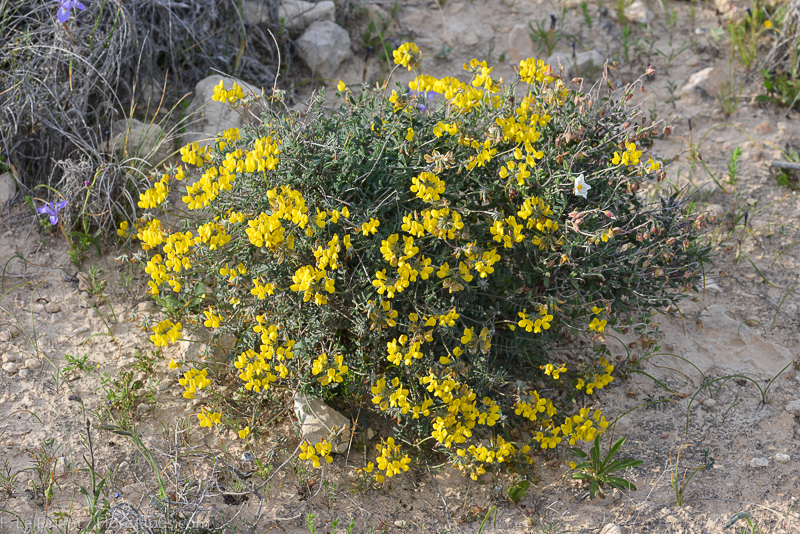
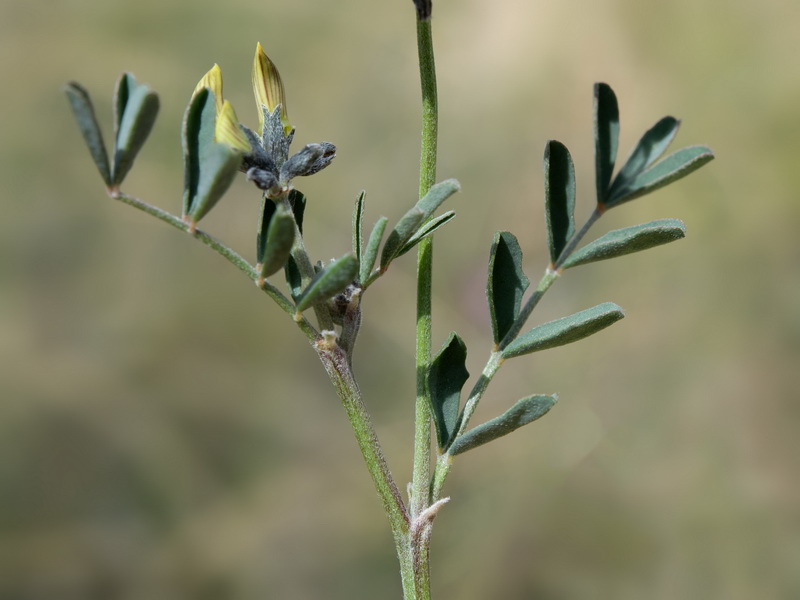
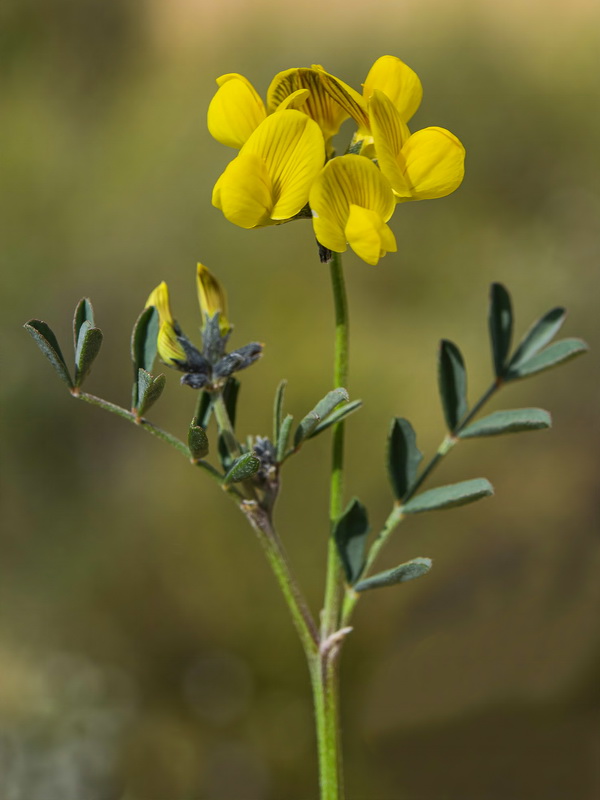
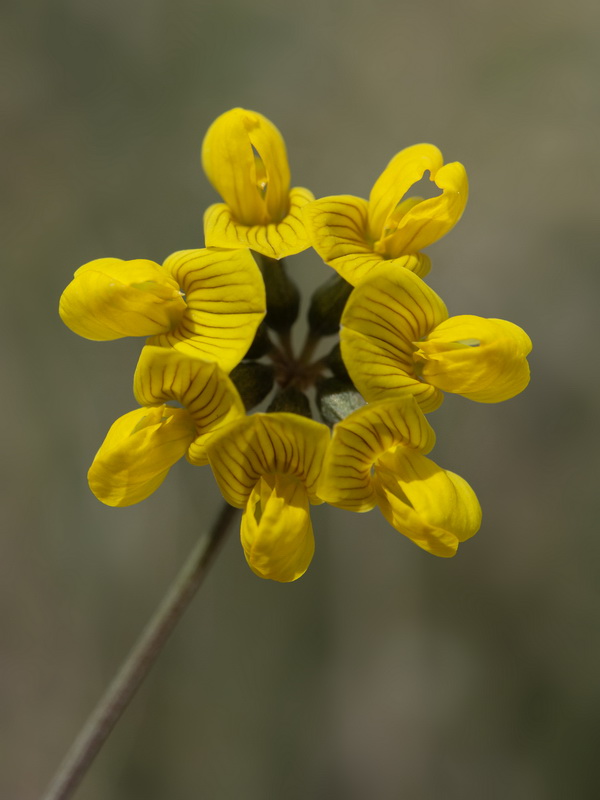
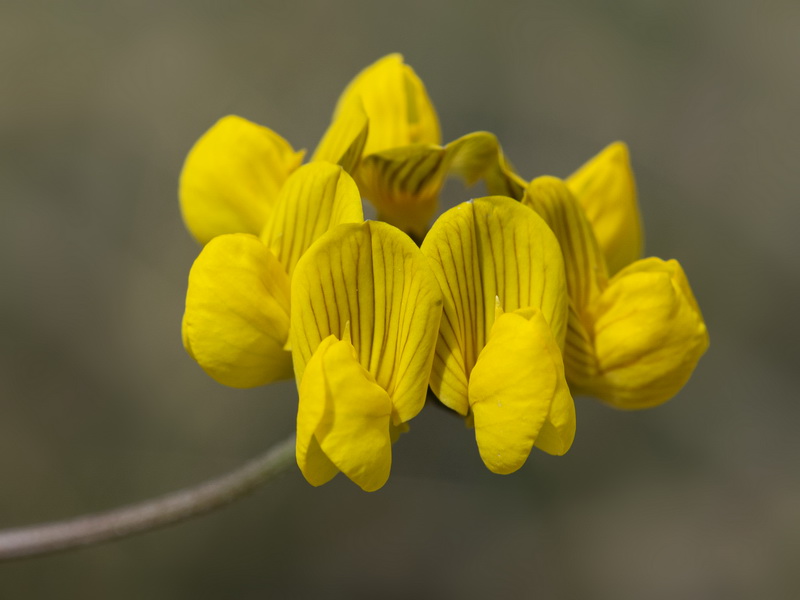
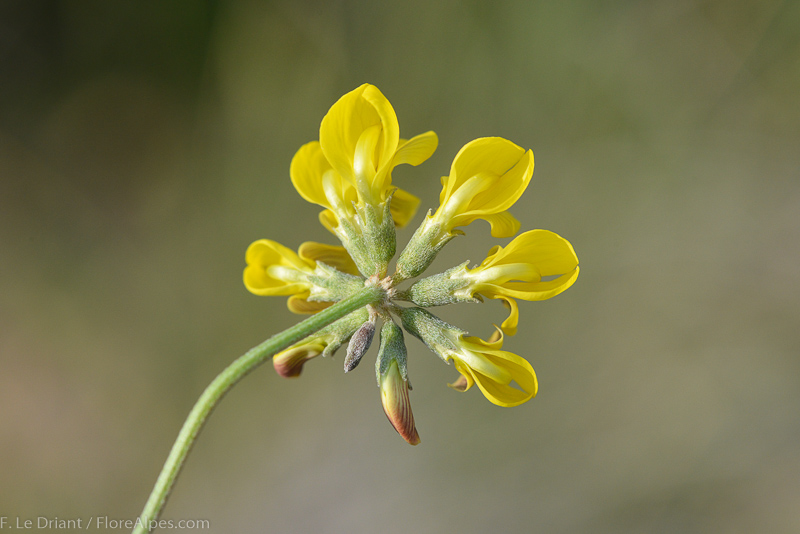
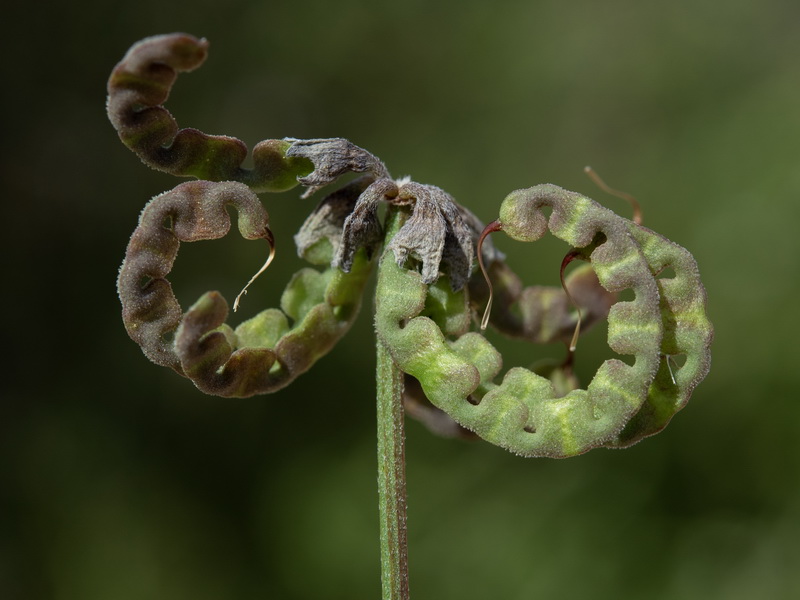
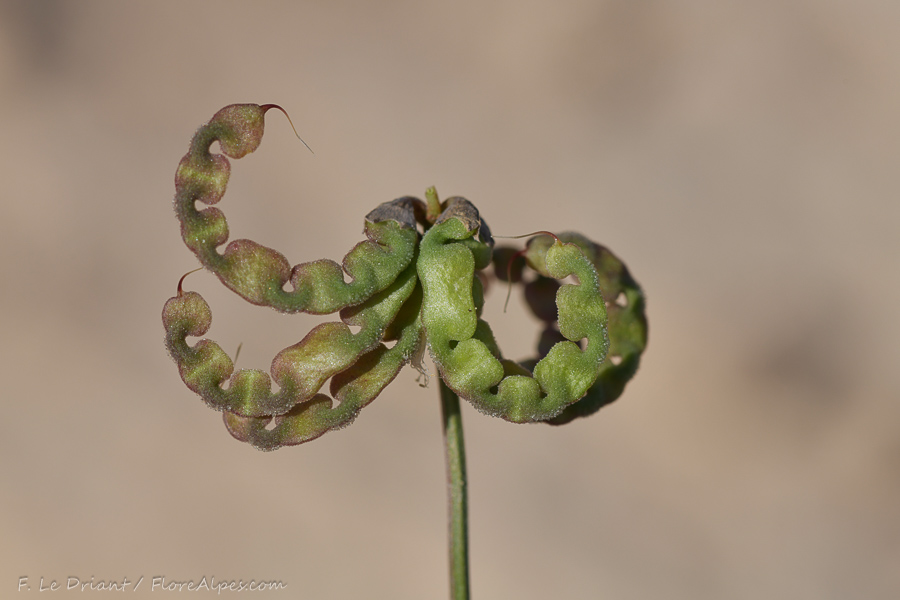
Hippocrepis scabra DC., it is a subshrub with a woody base from which several herbaceous stems arise annually; often sparsely sericeous, with appressed hairs 0.1-0.2 (0.3) mm long. Stems (6) 9-20 (40) cm, distinctly ribbed, generally bent at the nodes, zigzagging, decumbent or ascending, rarely erect, much-branched. Leaves up to 5 (7.5) cm, with 4-5 (7) pairs of leaflets; lower leaves petiolate, upper leaves sessile or sub sessile; stipules 1-2 x 0.5-0.7 mm, lanceolate, ± herbaceous, puberulous, with a purplish gland at the base next to the petiole, and sometimes another on the opposite margin next to the stem; leaflets 3.5-7 (11) x 2.5-4 (5) mm, generally somewhat fleshy, elliptic or obovate, retuse, apiculate, glabrous above and generally with scattered hairs beneath. Inflorescences axillary, pedunculate, with 3-5 (8) flowers; peduncle 12-30 (95) mm, 0.5-1.5 times the length of the subtending leaf; bracteoles c. 0.5 mm, ± membranous, bifid or laciniate, ± puberulous, with a ± visible glandular ring. Flowers spreading or pendulous, with a pedicel 1.5-2 (2.5) mm long, ± hairy. Calyx 3.5-4.5 (4.7) mm, campanulate, generally with scattered hairs; tube longer than the lips; Upper lip 1.5-2 mm, longer than the lower, with teeth 1.3-1.7 x 0.8-1 mm, slightly incurved; lower lip with teeth 1.2-1.8 x 0.9-1.1 mm, broadly triangular. Corolla yellow, frequently with purple veins on the back of the standard; standard 9-11 x 7-8 mm, ovate, apiculate, auriculate, with a claw 3-3.5 mm long, slightly exserted; wings 10-11 x 4-5 mm, with a claw c. 3 mm long; keel 7-8 x 2.7-3.2 mm, with a claw c. 3 mm long. Androecium diadelphous; anthers 0.5-0.6 mm. Ovary with 13-16 ovules; style c. 5 mm; stigma discoid, introrse. Fruit 12-40 x (3) 3.2-4 (4.3) mm, flattened, generally incurved into a semicircle or nearly annular, non-reticulate or with a very poorly developed reticulum, densely papillose, with circular or semicircular sinuses located on the inner side of the curve, containing (1) 5-11 seeds; seed-bearing zones semicircular or nearly circular, without developed margins; inter-seed zones highly developed, flat, notched on the ventral margin, rounded on the dorsal margin; papillae on the seed-bearing zones up to 0.2 (0.3) mm long, ± cylindrical. Seeds 0.7-1 x (2.4) 2.7-3 mm, horseshoe-shaped, ± circular in cross-section, reddish, greenish, or blackish.
Flowering in: Feb-Mar.



Leave a Reply