General Appearance
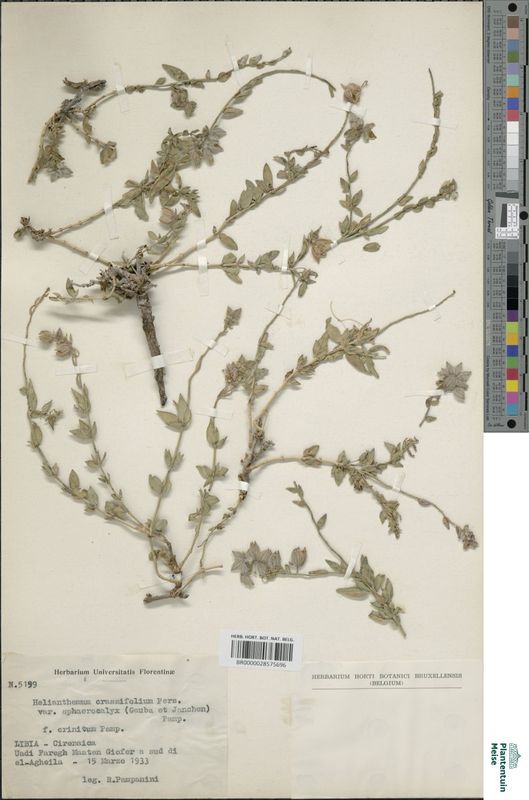
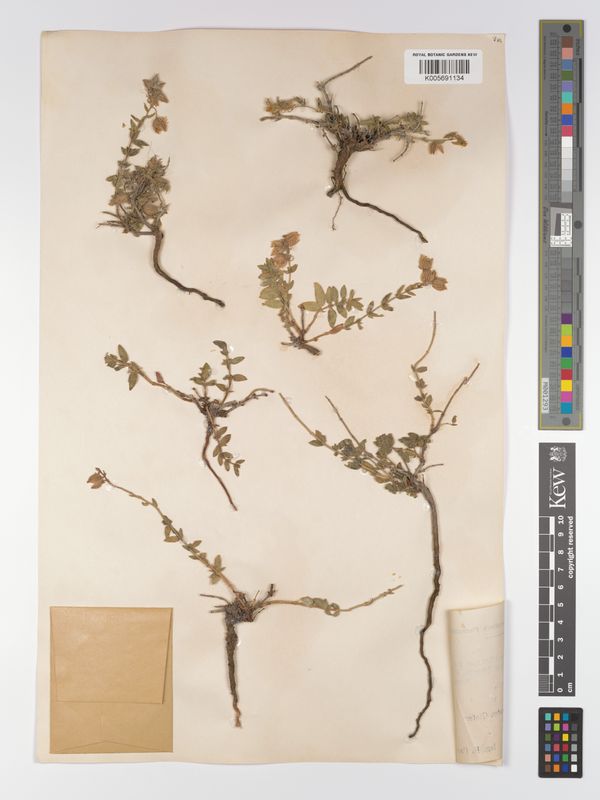
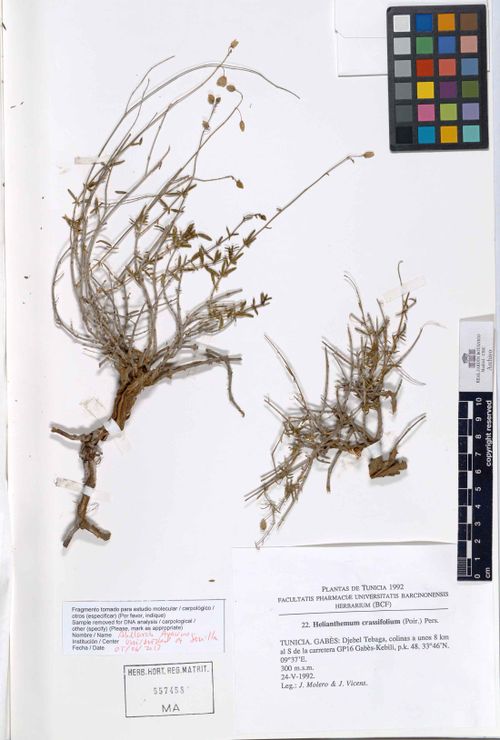
Helianthemum crassifolium Pers., it is an erect to ascending or spreading, caspitose shrublet, up to 25 (-30) cm long, glabrous to ciliately canescent on calyx. Leaves fleshy, flat to sub revolute, sessile or sub sessile, glabrous, consicuously large stipulate. lower leaves often broader, upper leaves narrower, ovate-sub triangulate to linear-oblong, up to 20-8 (-10) mm ascending to deflexed; stipules large, like smaller leaves. Raceme-like cyme c. 10-flowered, simple. Flowers 2-3 cm in diameter, yellow, with leaf like (exstipulate) bracts, pedicellate; pedicels up to 1 cm long, filiform, ascending to spreading, sub curved; calyx 6-8 mm long, ovate, acute, glabrous to sparsely or densely ciliate on the nerves. Capsules shorter than calyx, pubescent.
Life Form
Phytochoria
Distribution in Libya
Jabal Nafusa: (28 km) before Mizda 1974 (26 km) from Nalut, Gebal Nafousa, Shakshuk 1976
Al-Qibla area: Wadi Nesma region 2009 Wadis South of Mizda 2013
Notes
Wild, it is confined to Jabal Nafusa, and seems to grow on arid rocks.
This species is accepted: https://powo.science.kew.org/taxon/urn:lsid:ipni.org:names:168824-1
Link of images: https://www.gbif.org/taxon/3K5CM
First: Encyclopedia Flora of Libyan:
Jafri, S.M.H. & El-Gadi, A. (1977) Flora of Libya, Cistaceae Vol. (48) Department of Botany, Al-Faateh Univ., Tripoli, Libya. Page. 33.
Second: Researches and PhD theses, master theses, Sorted by Newest:
Mohamed, F.J. (2013) A Taxonomic Study of Wadis Flora South of Mizda at the intersections with Mizda-Sebha Highway. Master Thesis. Department of Botany-Faculty of Science-Sebha University. Libya. (In Arabic).
Bahri, N.M. (2009) Study of the vegetation covers of Wadi Nesma region, northwest of Libya. Master Thesis, Department of Botany, College of Science, Sebha University, Libya. (In Arabic).



Leave a Reply