General Appearance
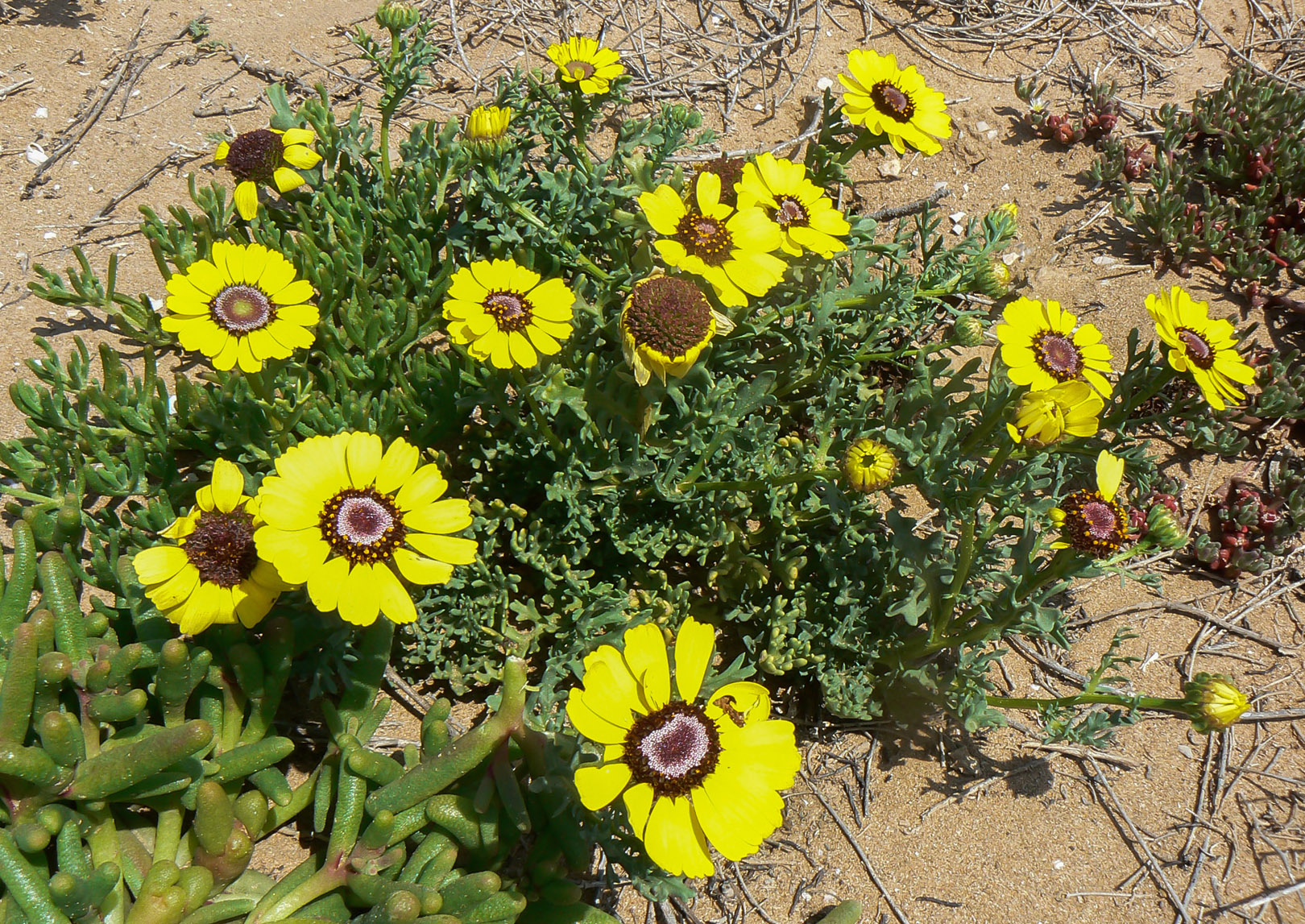
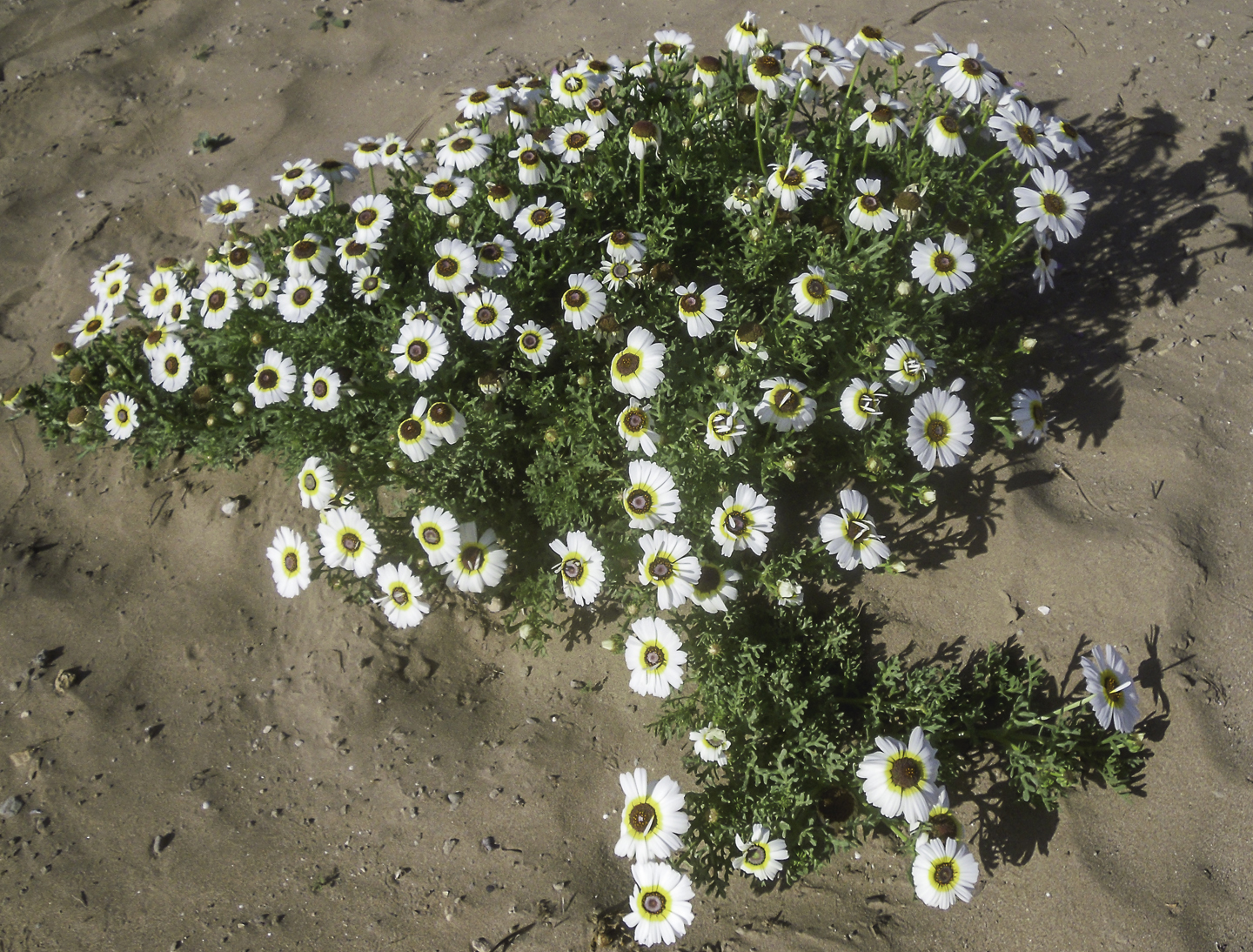
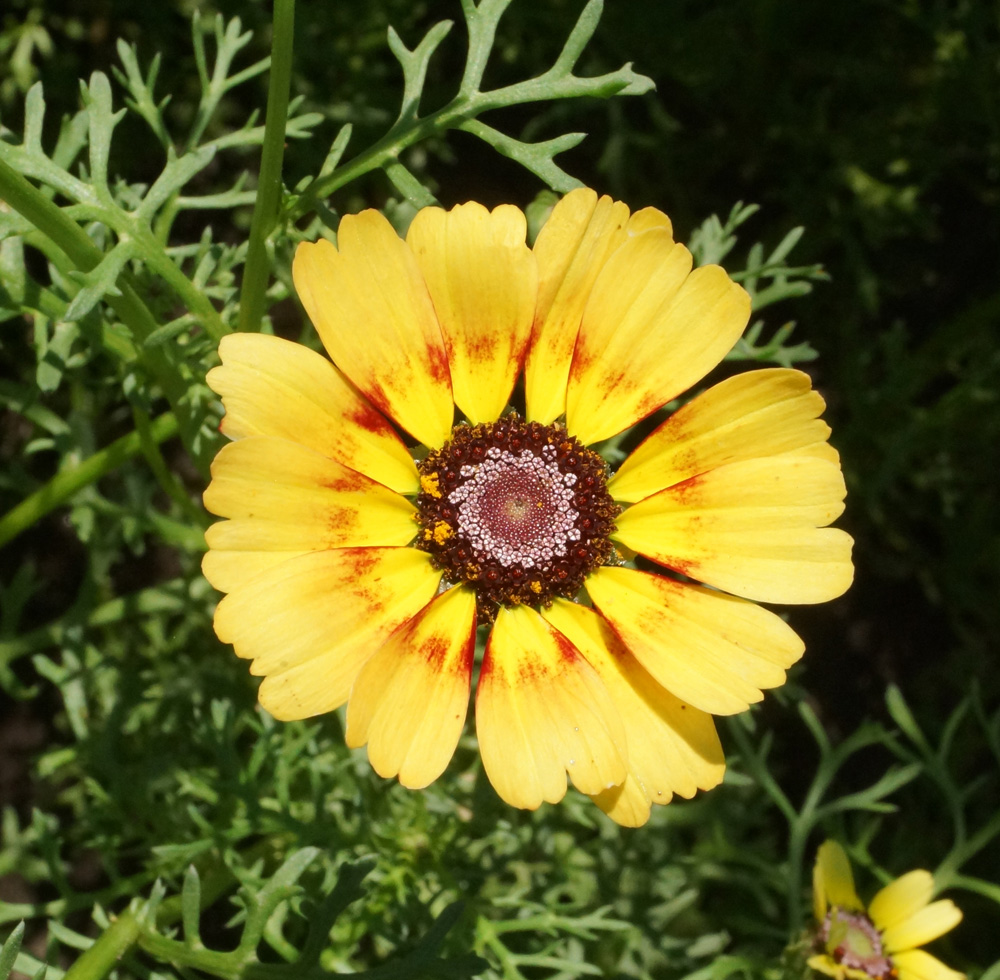
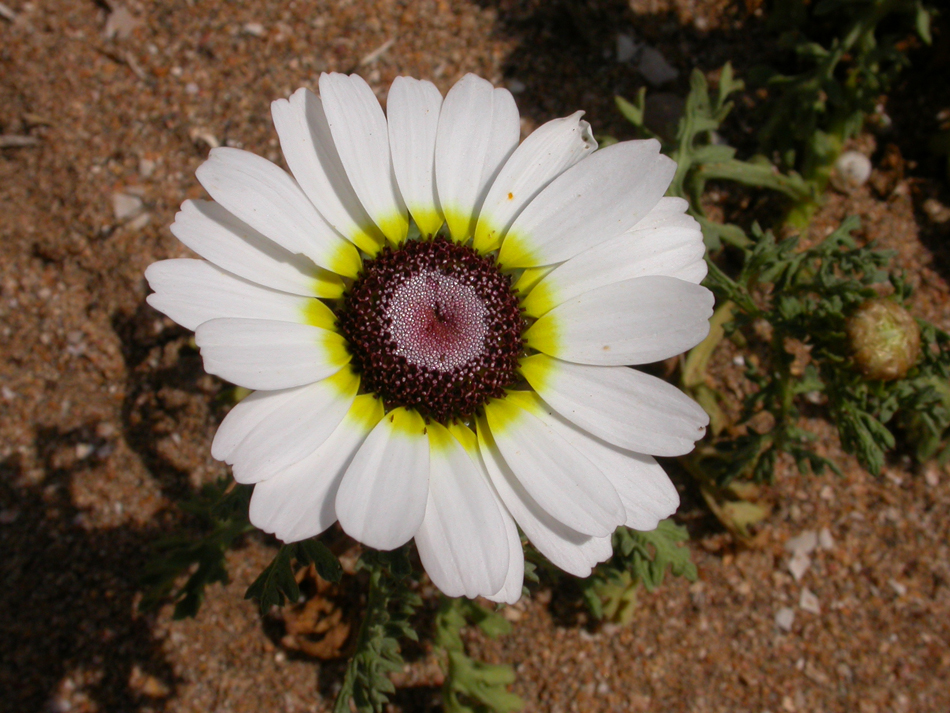
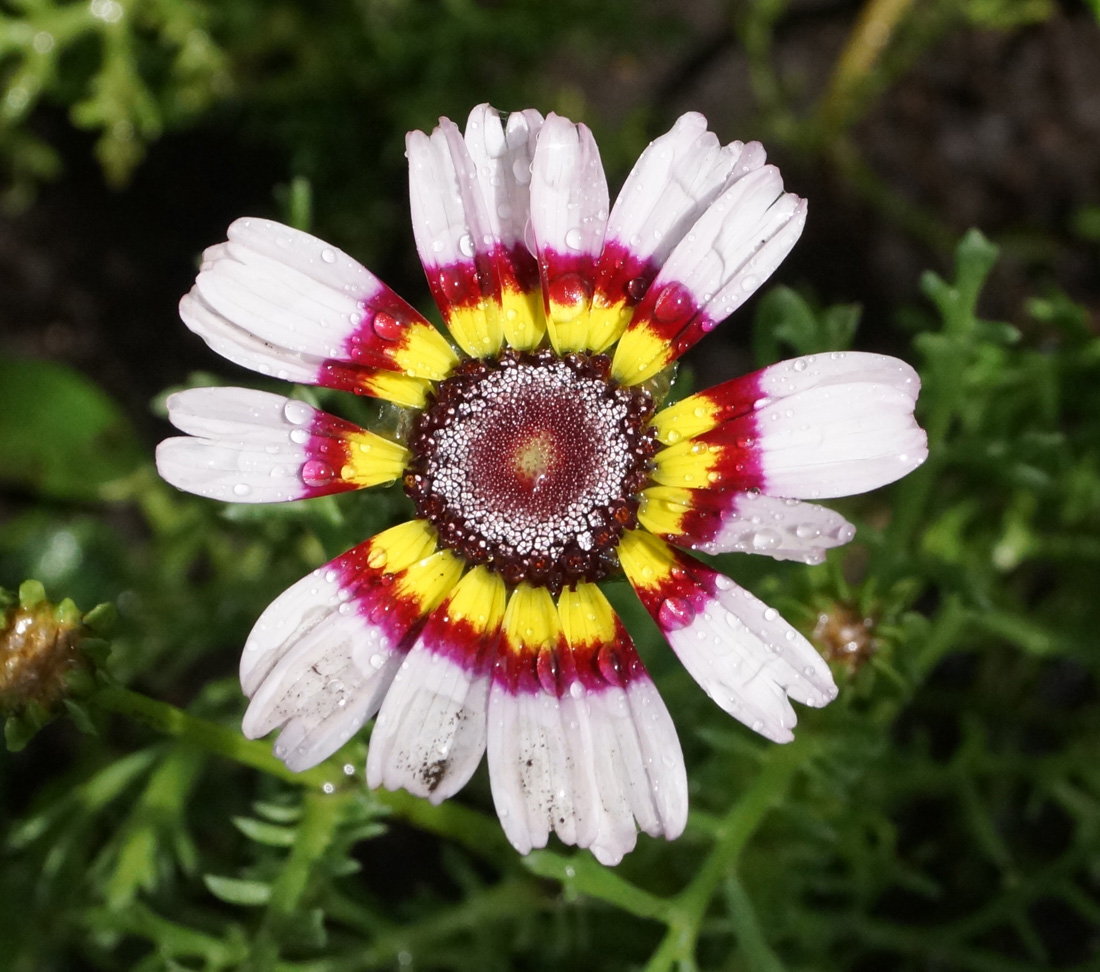
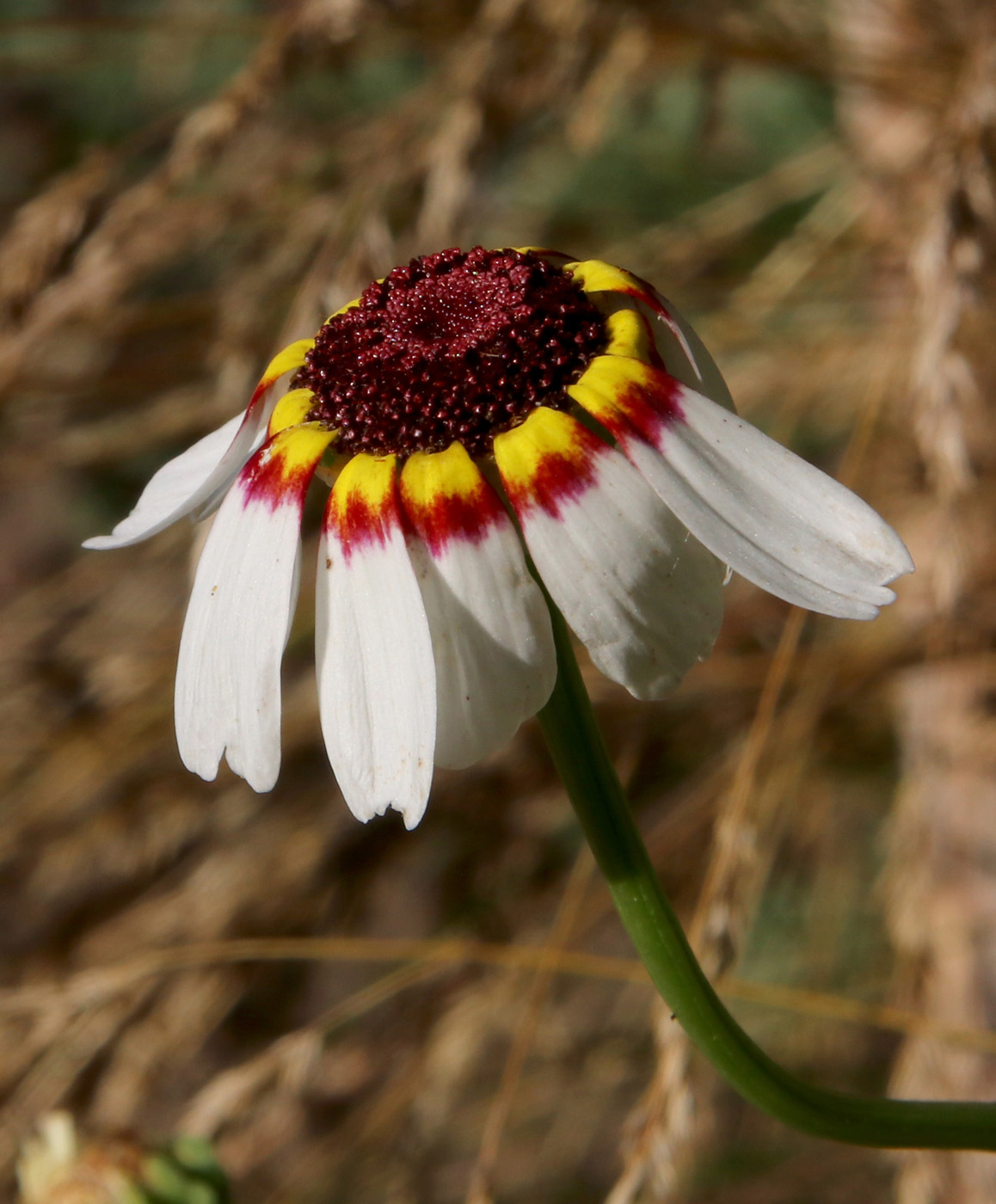
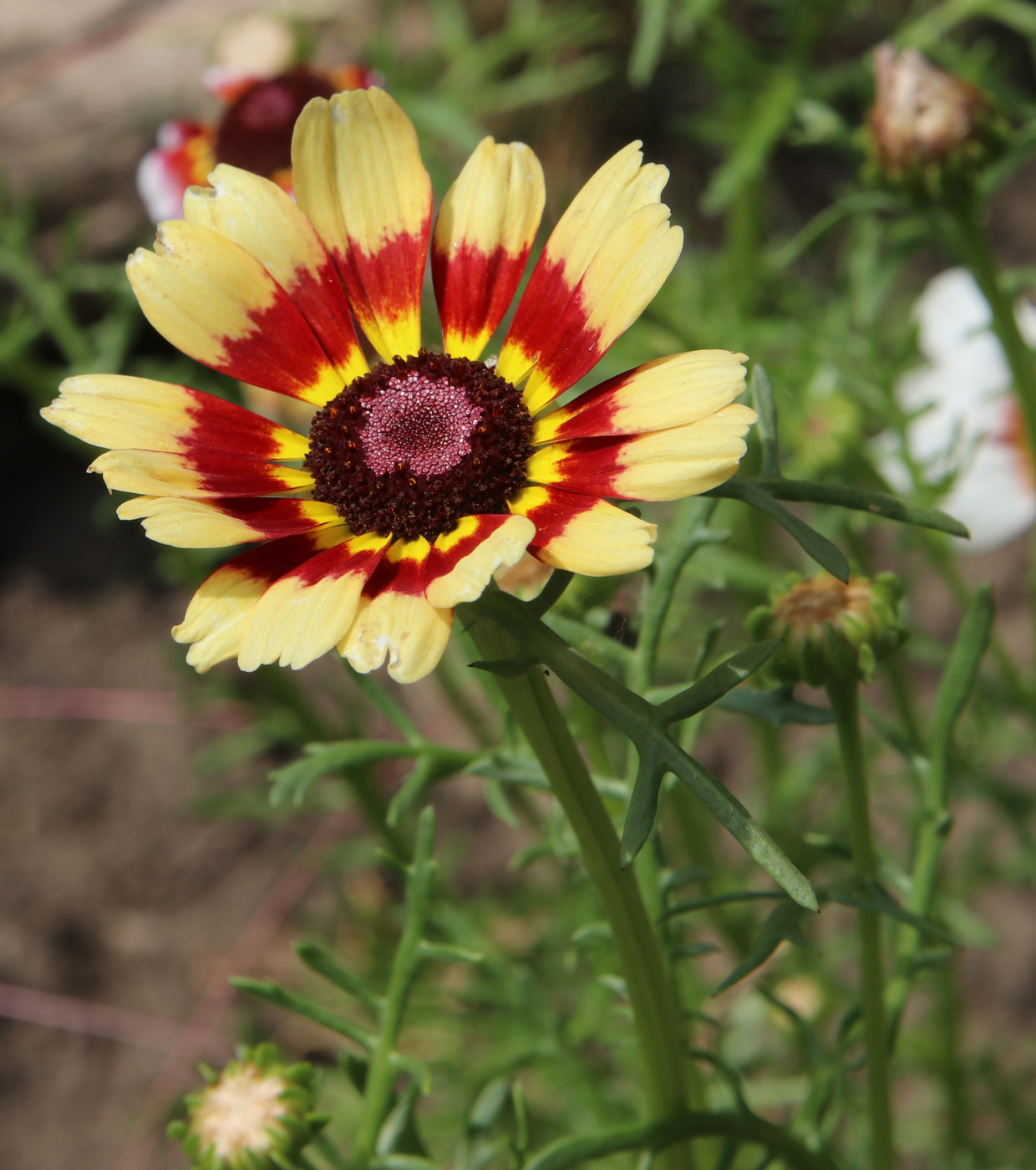
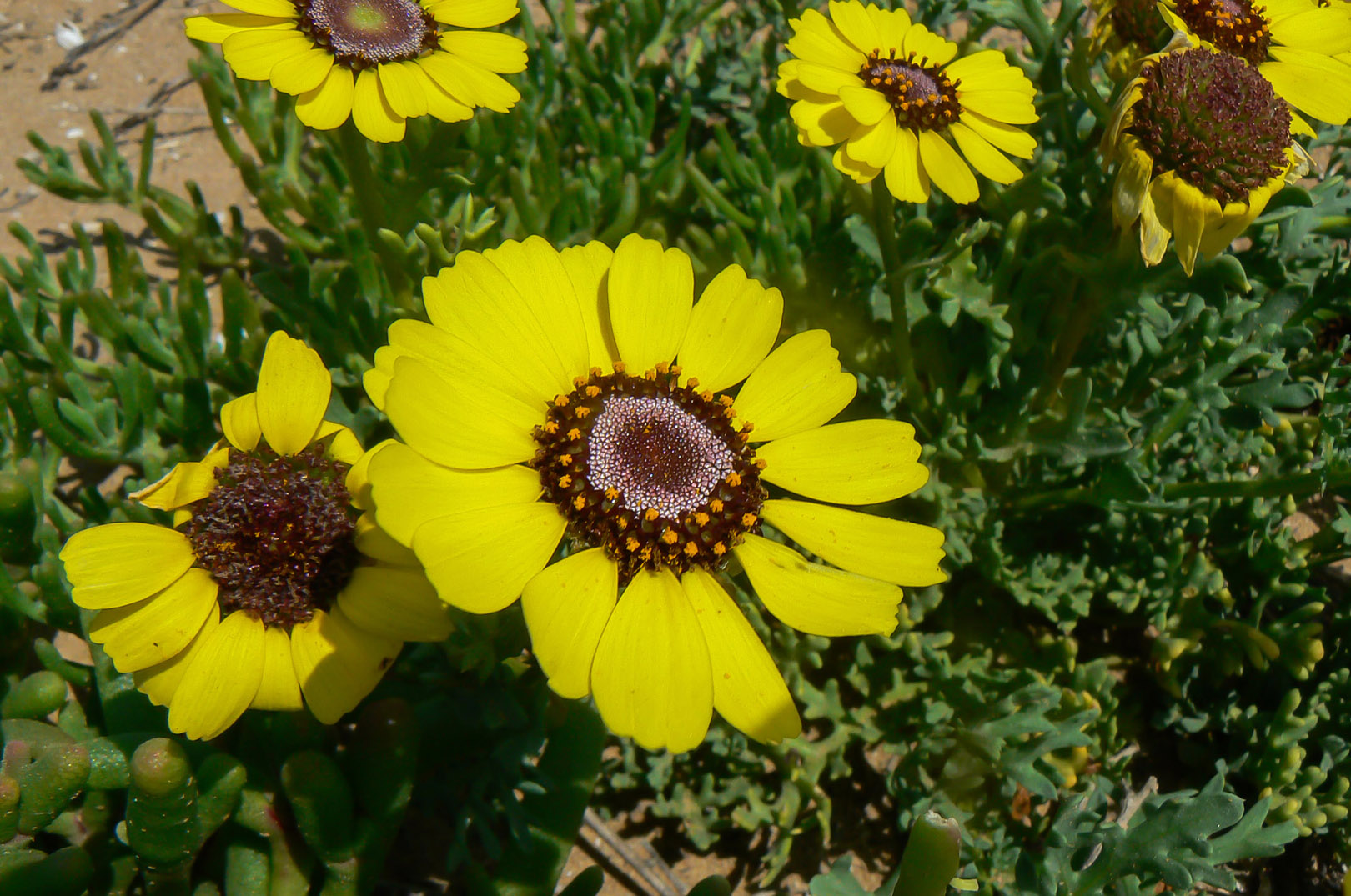
Ismelia carinata (Schousb.) Sch.Bip. / Homotypic Synonyms: Chrysanthemum carinatum Schousb., it is an annual herb. Stem, the aerial part is generally erect, simple or distally branched, average height 10-30 cm. Leaves mostly cauline, sessile (hugging the stem) or petiolate, are arranged alternately and have a 2-pinnate-lobed blade with terminal margins that are usually toothed, rarely entire. The blade contour is obovate or oblong. The surfaces are glabrous. Leaf size, 25–50 × 15–30 mm. Inflorescence consist of solitary or 2-3 flower heads gathered in a loose corymb-like formation, the inflorescences themselves consist of a terminal, radiate, pedunculated flower head. The flower heads consist of a meniscoid to hemispherical involucre, composed of 20-30 bracts, within which a receptacle serves as the base for two types of flowers. Ray florets and disk florets. The bracts, ranging in shape from ovate or obovate to lanceolate-deltate or lanceolate and more or less keeled, have a herbaceous consistency, are broadly hyaline on the margins and have resin canals, and are arranged in a more or less imbricated fashion in 2-4 rows. The convex receptacle lacks the straws that envelop the base of the flowers. Involucre diameter: 12-25 mm. The flowers are tetra-cyclic (i.e., formed by 4 whorls: calyx – corolla – androecium – gynoecium) and pentamerous (calyx and corolla formed by 5 elements). They are divided into: Ray florets (outer): 13 to 21 per flower head, female, fertile, and arranged in a row; the shape is ligulate (zygomorphic); sometimes they may be absent or sterile. Disc florets (central): They are more numerous (80-150) with short tubular shapes (actinomorphic); they are hermaphroditic and fertile. Calyx: The sepals of the calyx are reduced to a crown of scales. Corolla: Ray florets: The shape of the corolla is more or less tubular-funnel-shaped at the base, while it is ligulate at the apex; the ligule may end with some teeth; the color is generally yellow or white. Disc flowers: The shape is tubular, abruptly dividing into five lobes; the lobes, patent or erect, are delta-shaped or more or less lanceolate; the color is red or purple. Androecium: is composed of five stamens (alternating with the corolla lobes) supported by generally free filaments; the stamens are connate and form a sleeve surrounding the style. The anthers, with a collar of baluster-like filaments, can be either basifixed or medifixed. The endothecial tissue (inner lining of the anther) is almost always non-polarized. The pollen is spherical with an average diameter of approximately 25 microns; it is tricolporate (with three openings, either slit-like or isodiametric or pore-like) and echinate (with protruding tips). Gynoecium: The ovary is inferior, unilocular, and consists of two carpels. The style (the pollen receptor) is deeply bifid (with two divergent stigmas) and has separate or contiguous marginal stigmatic lines. The two arms of the style are truncated and may be papillose or covered with tufts of hairs. The fruits are achenes with pappus. In some species, there is a certain dimorphism between the achenes of the external ligulate florets (trigonal with three wings) and the tubular ones of the central disc (lattice with one or two wings). The apex is rounded at the margins or has a small crown. The pericarp lacks mucilaginous cells and resin sacs.
Life Form
Phytochoria
Distribution in Libya
Al-Jafarah Plain: Sabratha 2019 Sabratha region 2020
Sirte Plains: Wadi Soofejeen 2017
Benghazi Plain: Msus-Al-Ajramia zone 2004
Jabal Nafusa: Msallata (Shaafeen) 2008 Msallata National Park (Shaafeen) 2013 Msallata (Shaafien) 2017 Msallata-Garaboulli Province 2020
Al-Jabal Al-Akhder: Al-Abiar (Sidi Amohamed forest) 2020
Marmarica Plateau: From Tobruk to Egyptian Border 1999 Marmarica (north-eastern part of Libya) 2002 Dafna region (Tobruk to Msaid) 2008
Notes
Introduced in Libya???, cultivated as an ornamental plant; often found as an escape on refuse dumps.
Link of images: https://www.teline.fr/en/photos/asteraceae/ismelia-carinata, https://www.plantarium.ru/lang/en/page/view/item/69361.html
For more information
https://powo.science.kew.org/taxon/urn:lsid:ipni.org:names:226246-1, https://www.ipni.org/n/226246-1, http://www.worldfloraonline.org/taxon/wfo-0000029852, https://www.gbif.org/species/3091997, https://africanplantdatabase.ch/en/nomen/specie/138020/ismelia-carinata-schousb-sch-bip, https://www.plantarium.ru/lang/en/page/view/item/69361.html, https://hortflora.rbg.vic.gov.au/taxon/ada53d2a-5340-11e7-b82b-005056b0018f, https://www.teline.fr/en/photos/asteraceae/ismelia-carinata, https://it.wikipedia.org/wiki/Ismelia_carinata
First: Encyclopedia Flora of Libyan:
Jafri, S. M. H. & El-Gadi, A. (1983) Flora of Libya, Asteraceae Vol. (107) Department of Botany, Al-Faateh Univ., Tripoli, Libya.
Second: Researches and PhD theses, master theses, Sorted by Newest:
Saaed, M.W.B., EL-Barasi, Y.M. & Rahil, R.O. (2021) An updated checklist and quantitative analysis of the Marmarica Plateau flora, in the north-eastern part of Libya. Phytotaxa 509 (1): 001-055. https://phytotaxa.mapress.com/pt/article/view/phytotaxa.509.1.1
An-updated-checklist-and-quantitative-analysis-of-the-Marmarica-Plateau-flora-مضغوط
Al-Amrouni, M, M., Al-Zarbi, A., Al-Aeb, M. A. (2020) Study of vegetation cover in Sidi Amohamed forest north of the city of Al-Abyar in the Al-Jabal Al-Al-Akhdar. Libya. Journal of Quality Assurance for Scientific Research-The first issue-April-2020 (In Arabic). https://lqac.org.ly/wp-content/uploads/2020/05/PDF-1.pdf, https://independent.academia.edu/ABDULHAMIDALZERBI
دراسة الغطاء النباتي بغابة سيدي امحمد شمال مدينة الابياربالجبل الاخضر.2020
Al-khojah, H.M., Al-Yafour, L.A., Mahklouf, M.H. (2020) Floristic Study of Selected Districts in Sabratha region Libya. J. of Advanced Botany and Zoology Volume 7/Issue 4 ISSN: 2348-7313. https://scholar.google.com/citations?user=2s5EMysAAAAJ&hl=ar, https://www.researchgate.net/profile/Mohammed-Mahklouf
Floristic Study of Selected Districts in Sabratha region Libya. 2020.
Mahklouf, M.H., Sherif, A.S., Betelmal, A.G. (2020) Floristic Study and Species Diversity of Msallata-Garaboulli Province in Libya. J. of Advanced Botany and Zoology Volume 7 / Issue 3 ISSN: 2348-7313. https://www.researchgate.net/profile/Mohammed-Mahklouf, https://www.researchgate.net/publication/341306643_Floristic_Study_and_Species_Diverisy_of_Msallata-Garaboulli_Province_in_Libya
Floristic Study and Species Diverisy of Msallata-Garaboulli Province. 2020
Saed, Z.H. S., Abohbell, H.A., Mahklouf, M. H. (2019) Floristic Analysis of the Family Asteraceae in Sabratha city- Libya. American Journal of Life Science Researches 2019; 7(1): 18-25 Published online January, 2019.
Floristic Analysis of the Family Asteraceae in Sabratha city- Libya. 2019
Bahri, N.M. (2017) Identify, Limit and Determine the Vegetation Types of Wadi Ka’am Areas, Libya. Journal of Marine Sciences and Environmental Technologies-Volume (3) -Issue (2) (In Arabic) https://www.researchgate.net/publication/371282756_altrf_ly_alanwa_alnbatyt_lmnatq_wady_kam_whsrha_wthdyd_ashkal_nmwha
التعرف على الانواع النباتية لمناطق وادي كعام وحصرها وتحديد أشكال نموها. 2017 .
Al-Masalati, N. A. A. (2013) Plant diversity across the altitudes of the Msallata National Park Reserve Mountains. Master Thesis. Botany Department-College of Science-University of Benghazi-Libya. (In Arabic).
Barrani, M. W. (2008) A study of environmental degradation factors in the semi-desert Dafna Region-Libya. Master Thesis-Department of Science and environmental Engineering-Postgraduate Academy Benghazi branch. (In Arabic).
El-Yafour, L. A. (2008) Taxonomic study of the vegetation properties of Sabratha city Master Thesis. Department of Botany, Faculty of Science, Al-Zawiya University, Libya. (In Arabic).
Mohammed, S.A.H. (2008) A taxonomic and ecological study of the plants of the Shaafin Reserve in Masalatah. Master Thesis. Department of Biology-Faculty of Arts and Sciences-Al-Mirqab University. Al-Khums. Libya. (In Arabic).
El-Jetlawi A.O.(2004) Study of vegetation and soil seed bank of a range desert zone (Msus-Al-Ajramia), Master of Science Thesis, Botany Department, Faculty of Science, Benghazi University, Benghazi, Libya (In Arabic).
El-Shaary M.S. (2002). The Natural Vegetation in Marmarica plateau (North-eastern Libya). First ed. Tobruk (Libya): Published by the local Authority. (In Arabic).
EL-Habony, A.M. (1999) Vegetation and flora of a sector along Mediterranean cost of Libya from Tobruk to Egyptian border, M.Sc. Thesis, Botany Department-Faculty of Science-Garyounis University, Benghazi, Libya. (in Arabic).

Leave a Reply