Cornulaca monacantha Delile

Common Name: Suda -Tahara
Family: Amaranthaceae
Flowering Time: Oct-Nov

General Appearance

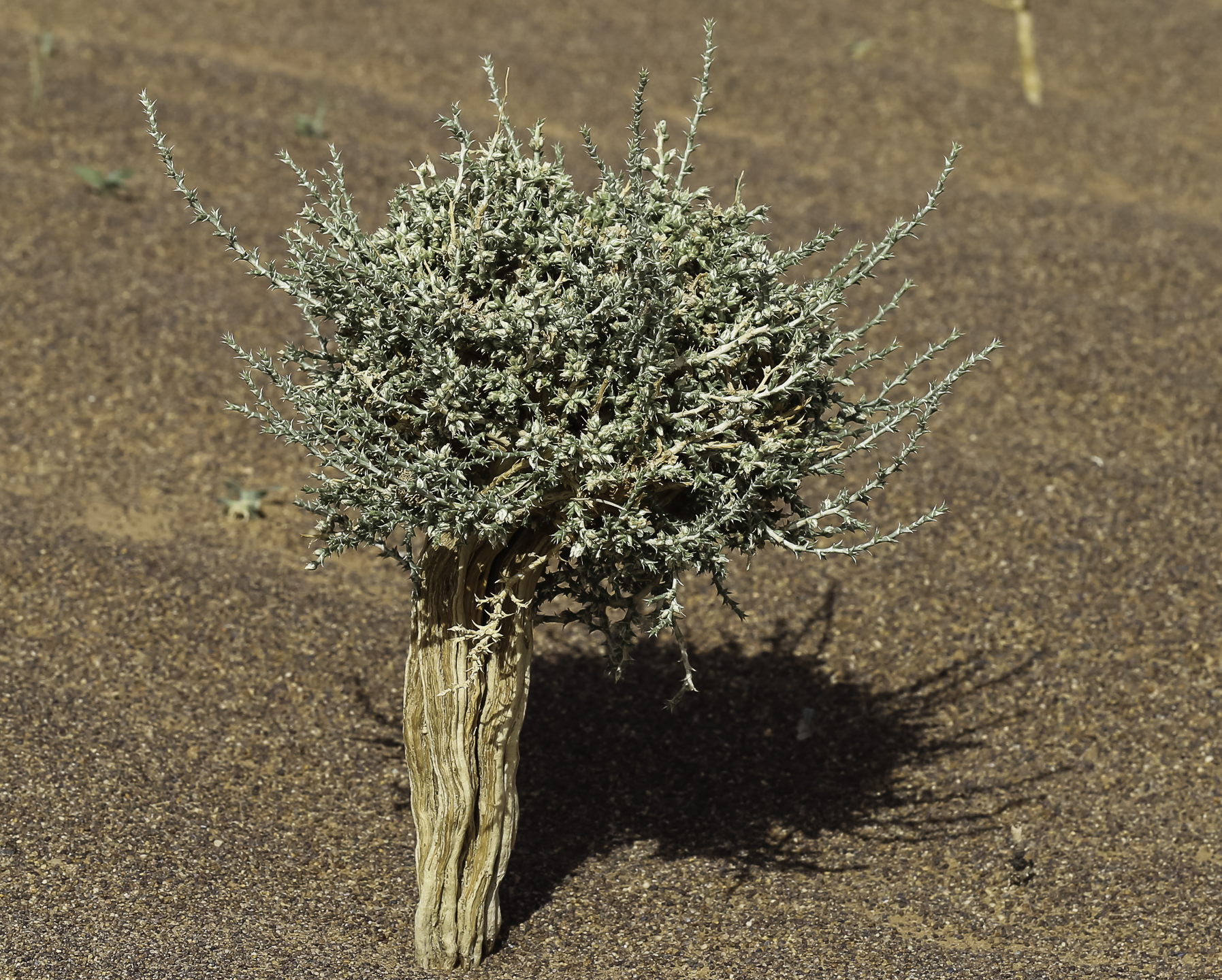
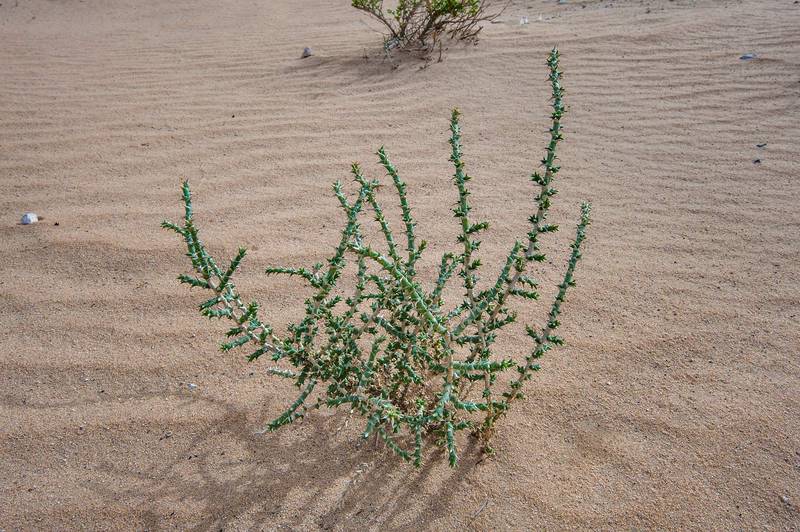
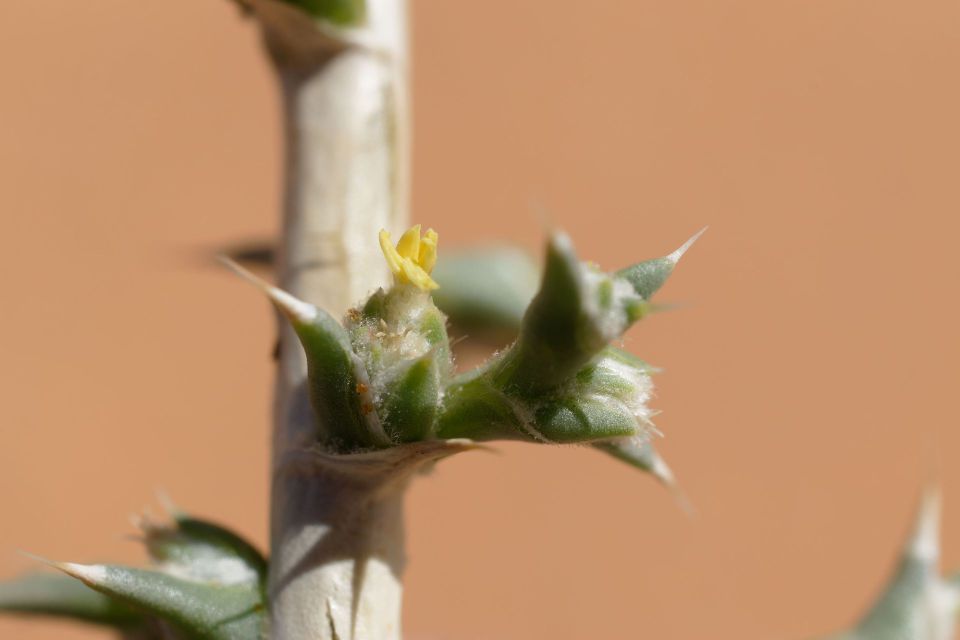
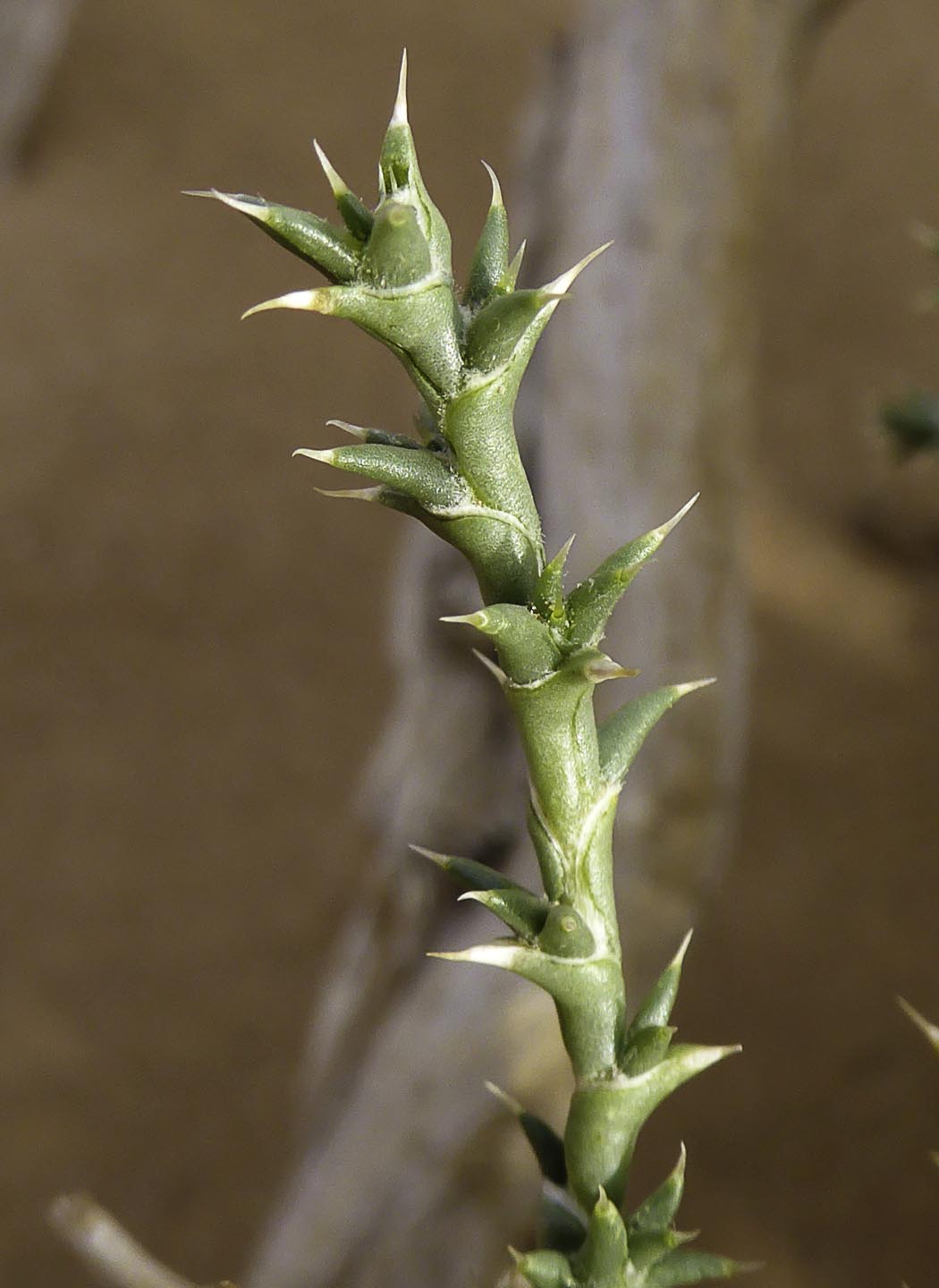
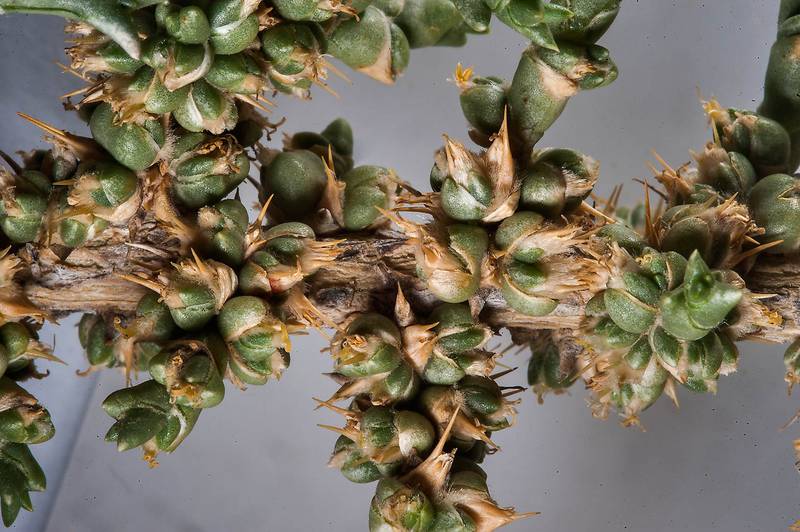
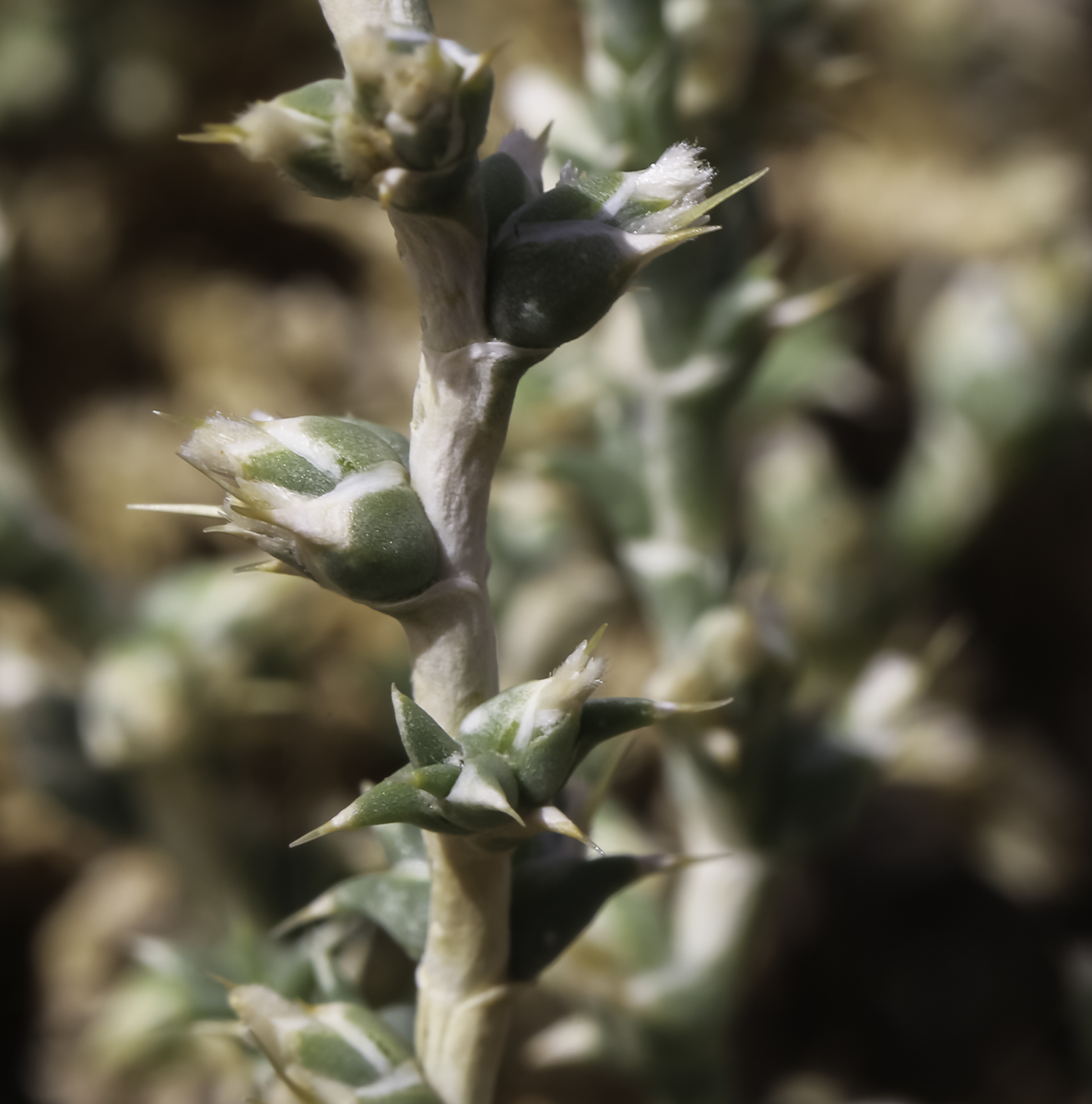
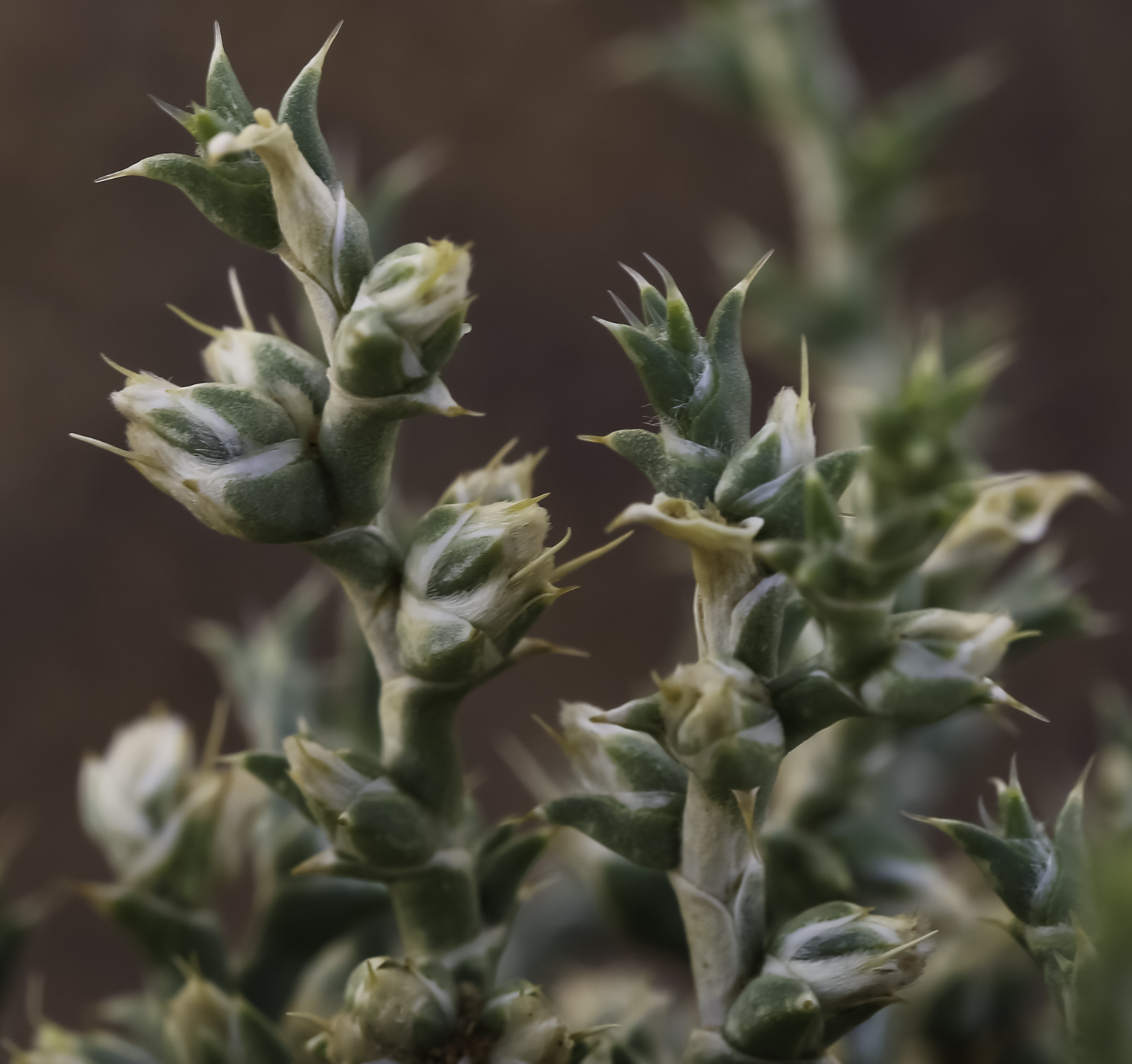
Cornulaca monacantha Delile, it is a straggling, branched, woody shrub growing to a height of 60 cm. The stubby bluish-green leaves are scale-like and clasp the greyish, wiry stems. They each have a single stiff spine at the tip, hence the specific name monacantha. Leaves up to 10 x 2 (-2.5) mm, recurved, tapering from a clasping base into a rigid spine, woolly in the axils, the leaves turn yellow or white when the plant is dead. The orange-brown flowers appear singly in the woolly leaf axils. Flowers 1-3 (-5) in each axil, exceeding the bracteoles; bracts up to c. 4 mm, spinescent. Perianth-segments c. 5 mm, linear, subspathulate, obtuse, ± denticulate at apex, coriaceous below, membranous above, the anterior one usually developing an up to 8 (-10) mm long spine at the back. The seeds are held vertically in an erect, flattened seed pod.

Life Form

N.Ph

Phytochoria

SA+SZ. The native range of this species is Sahara to W. & SW. Pakistan.

Distribution in Libya

Zliten-Misurata Plain:

Misurata 2006

Sirte Plains:

Sirte 2016

Jabal Nafusa:

Msallata (Shaafien) 2017

Marmarica Plateau:

Reported in Marmarica north-eastern part of Libya by Pampanini 1930  Marmarica (north-eastern part of Libya) 2002

Al-Jufra area:

EL-Harouge mountain 2012

Fezzan area:

Fekkim,(130 km) from Brak,(16 km) from the main road to Brak (15,20 km) from Sebha, between Sebha and Al-Abiad, Wadi Tumb 1973  Gaber-Oun Lake 2012

Gebel Al-Uweinat:

Gebel Uweinat 1968

Notes

Wild in Libya, medicinal plant, the plant is wind resistant and has a long.  Despite its spiny leaves, it provides good grazing for camels and is said to increase the supply of milk produced by lactating females.

First: Encyclopedia Flora of Libyan:

Jafri, S. M. H. & El-Gadi, A. (1978) Flora of Libya, Chenopodiaceae Vol. (58) Department of Botany, Al-Faateh Univ., Tripoli, Libya.

Second: Researches and PhD theses, master theses, Sorted by Newest:

Saaed, M.W.B., EL-Barasi, Y.M. & Rahil, R.O. (2021) An updated checklist and quantitative analysis of the Marmarica Plateau flora, in the north-eastern part of Libya. Phytotaxa 509 (1): 001-055. https://phytotaxa.mapress.com/pt/article/view/phytotaxa.509.1.1

Bahri, N.M. (2017) Identify, Limit and Determine the Vegetation Types of Wadi Ka’am Areas, Libya. Journal of Marine Sciences and Environmental Technologies-Volume (3) -Issue (2) (In Arabic)  https://www.researchgate.net/publication/371282756_altrf_ly_alanwa_alnbatyt_lmnatq_wady_kam_whsrha_wthdyd_ashkal_nmwha

Almathnani, A. M., Ali Elssaidi , M. and Mohamed, M. I. (2012) Diversity and Ecological Succession Around Gaber-Oun Hypersaline Lake Ecosystem-Libya. 2nd International Conference on Ecological, Environmental and Biological Sciences (EEBS’2012) Oct. 13-14, 2012 Bali (Indonesia).  https://scholar.google.com/citations?user=JdnAB7IAAAAJ&hl=en

EL-Barasi,Y.M., Bader, B.M., Barrani. M.W., EL-Hashani, N.M. and Alamrouni, A.O. (2018) Ecological studies on EL-Jufra Desert Depression. https://www.researchgate.net/profile/Yacoub-El-Barasi

Al-Dana, S. M. M. (2006) Taxonomic study of wild flower plants in some areas of Misrata. Master Thesis, Department of Botany, Faculty of Science, Misurata University (7 October previously) Misurata, Libya. (In Arabic)

El-Shaary MS. 2002. The Natural Vegetation in Marmarica plateau (North-eastern Libya). First ed. Tobruk (Libya): Published by the local Authority. (In Arabic)

 

Leave a Reply

Your email address will not be published. Required fields are marked *