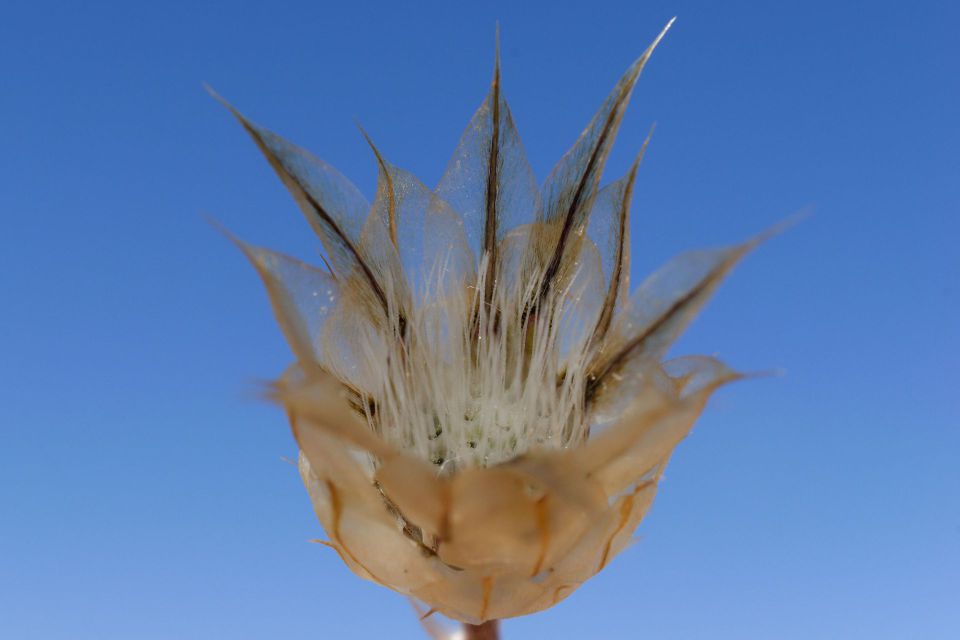
Catananche arenaria Coss. & Durieu

Common Name: Geez el Ghazal.
Family: Asteraceae
Flowering Time: Mar-Apr.

General Appearance

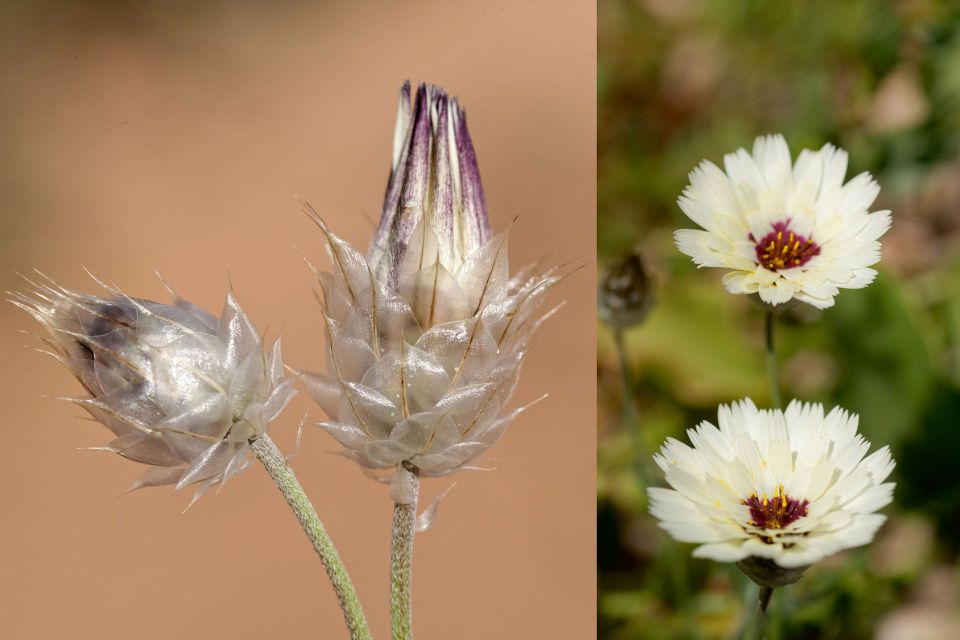
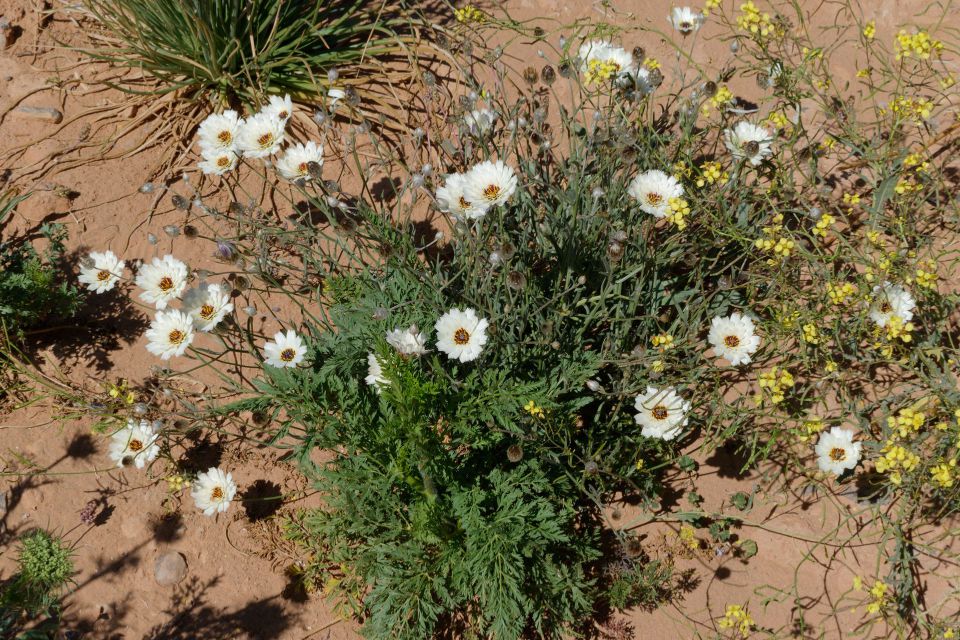
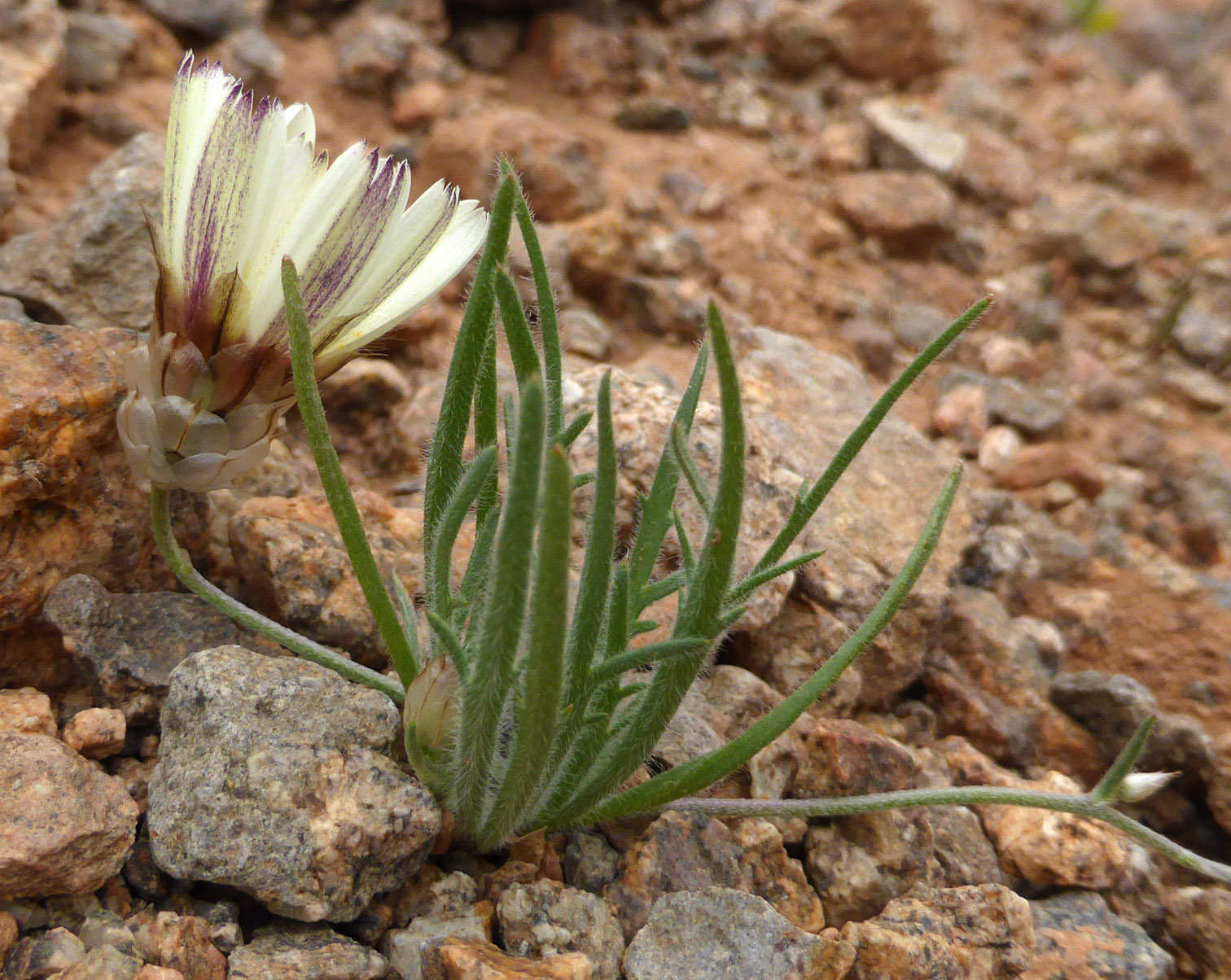
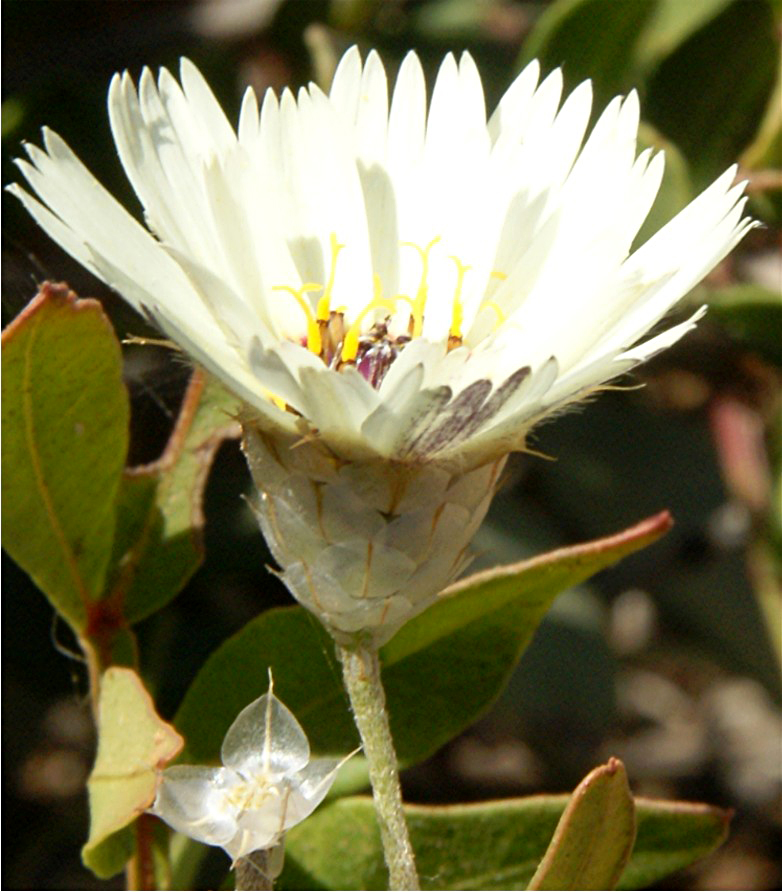
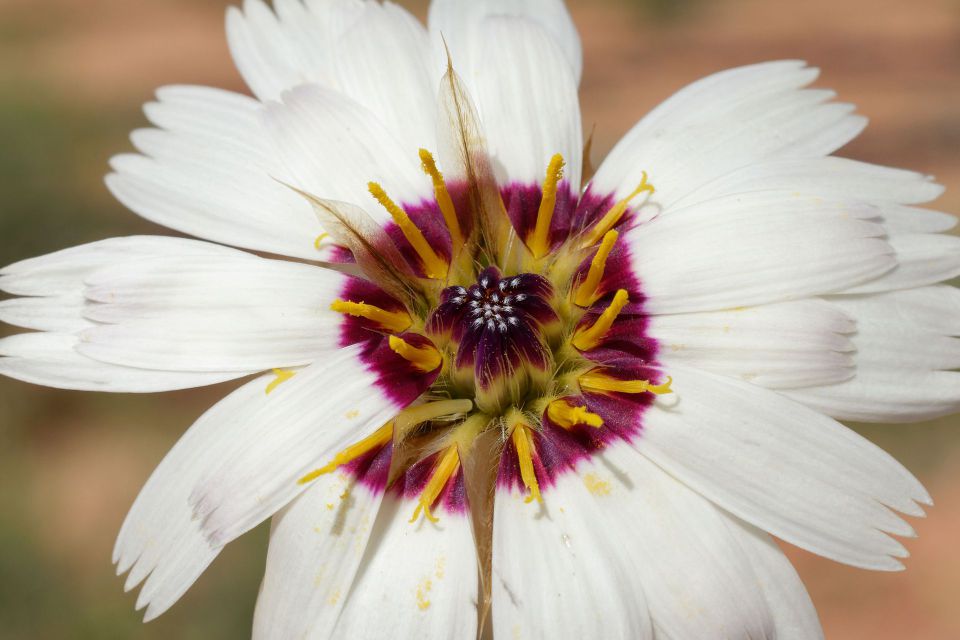
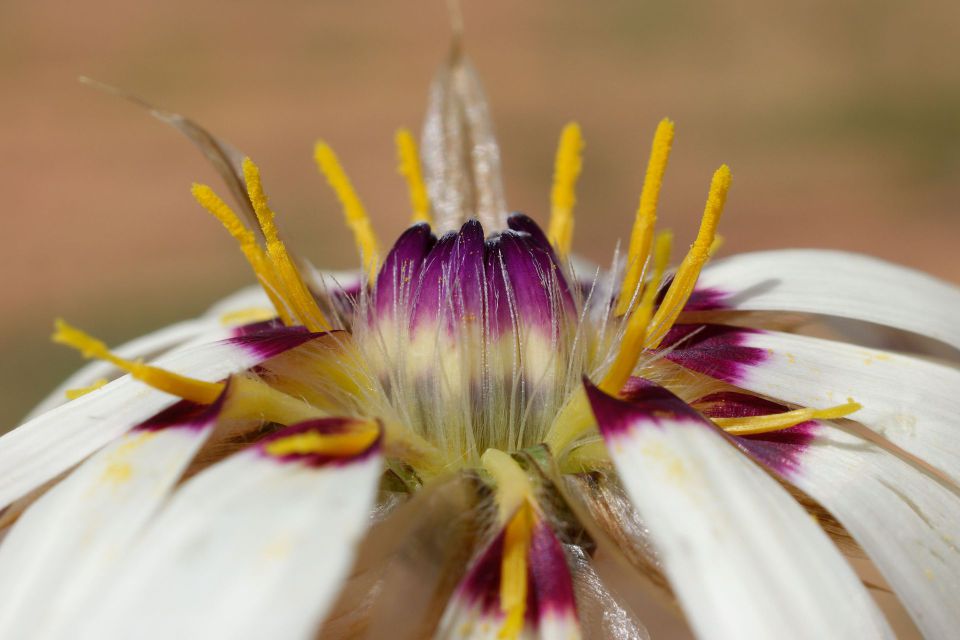
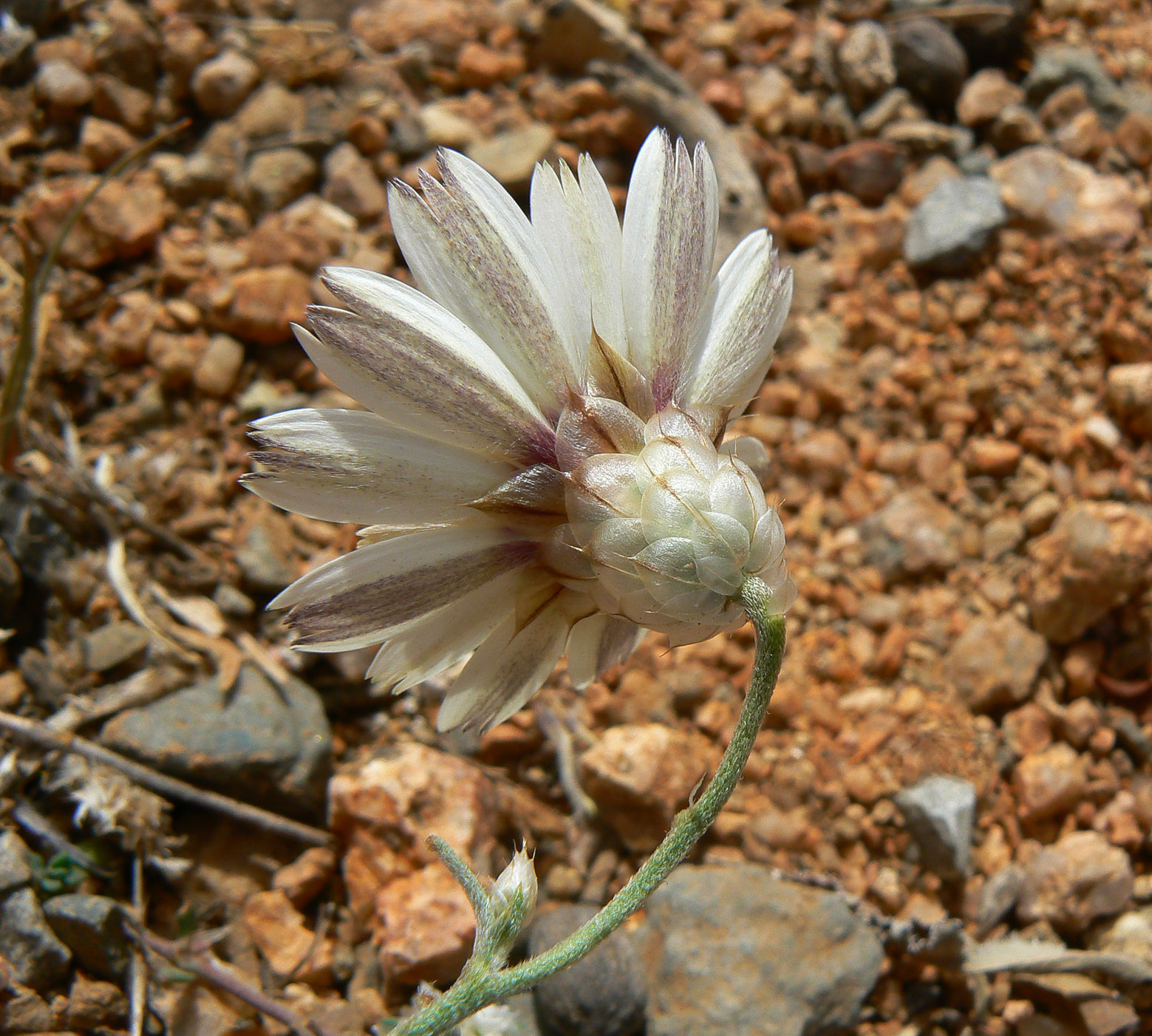
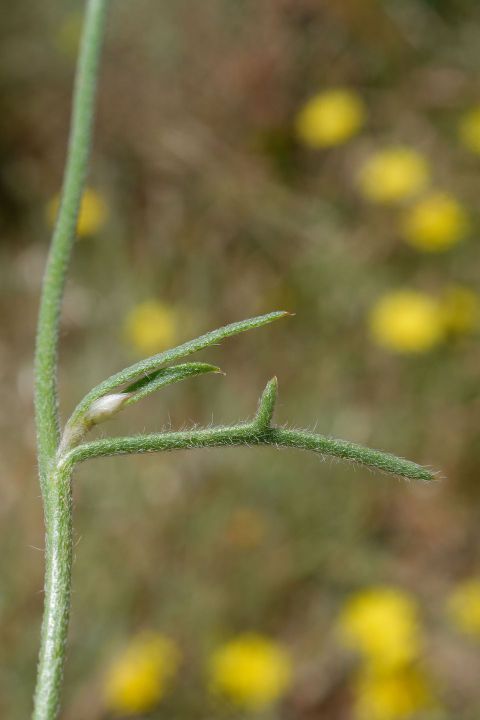
Catananche arenaria Coss. & Durieu, it is an annual, appressed, hairy herbaceous or suffrutescent, simple or branched, up to (5-) 10-25 (-40) cm tall.  Leaves very narrow, simple, entire or pinnatilobed, appressed hairy, mostly crowded into basal rosette; those of the rosette and lower cauline ones up to 7 cm long; upper cauline leaves up to2.5 cm long. Capitula I (-2). terminal on each branch, pedunculate or sub sessile, as well as sometime a few, sessile, additional capitula in the axils of the rosette leaves; sometimes 1-2 leafy bracts present below the capitulum; peduncles 2-10 (-15) cm long. Involulcre (10-) 15-20 mm long; involucral bracts (4-) 5-6 rowed, scarious with brownish midrib, acuminato-aristate. Outermost involucral bracts 4 x 2 mm, ovate. Involucral bracts of the 2nd row 6.5 x4 mm, broadly ovate, strongly concave. Involucral bracts of the 3rd row 8.5 (-9) x 5 mm, broadly ovate, lower part abruptly narrowed into flat, ± weak coriaceous stalk (c. 2 mm). Involucral bracts of the 4th row 10 (-11.5) x 6-6.5 mm, similar to the preceding involucral bracts (basal part c. 3 mm, coriaceous body with strong lateral scarious wings). Innermost involucral bracts 14-15 x 2.5 mm, linear-lanceolate, weakly narrowed at c. the middle. Ligules yellow, up to c. 1.5 times longer than the involucre, soft hairs on the under surface. Cypsela 3.5 mm long, obeonical, 5-ribbed; ribs hairy; pappus homomorphic, of 5 scales; scales ovate, imbricate. thin papery. 3 x 1 mm, inconspicuously white tuberculate, aristate; arista 7·8 mm long, scabrid-white.

Life Form

Th

Phytochoria

SA. The native range of this species is W. & Central Sahara.

Distribution in Libya

Al-Jafarah Plain:

Wadi El-Atal 1975

Sirte Plains:

Bir el Churgia, Misurata–Sirte road 1958  Weshka, (27 km) from Weshka 1975

Jabal Nafusa:

Msallata (Shaafien) 2017

Al-Jabal Al-Akhder:

From Zawiet Tamula to Al-Manarh, From Lustata to Beshtaya 2019   Al-Abiar (Sidi Amohamed forest) 2020

Al-Qibla area:

Wadis South of Mizda 2013

First: Encyclopedia Flora of Libyan:

Jafri, S. M. H. & El-Gadi, A. (1983) Flora of Libya, Asteraceae Vol. (107) Department of Botany, Al-Faateh Univ., Tripoli, Libya.

Second: Researches and PhD theses, master theses, Sorted by Newest:

Al-Amrouni, M, M., Al-Zarbi, A., Al-Aeb, M. A. (2020) Study of vegetation cover in Sidi Amohamed forest north of the city of Al-Abyar in the Al-Jabal Al-Al-Akhdar. Libya. Journal of Quality Assurance for Scientific Research-The first issue-April-2020 (In Arabic). https://lqac.org.ly/wp-content/uploads/2020/05/PDF-1.pdf,  https://independent.academia.edu/ABDULHAMIDALZERBI

دراسة الغطاء النباتي بغابة سيدي امحمد شمال مدينة الابياربالجبل الاخضر.2020

Ali, A. M., Lashhab, S. R., Abu-Aweena, A. A.M. (2019) Classification of vegetation cover and its geographical distribution in the area extending between Al-Haniya and Wadi Zagzoog in the north to Lasastata and Bishtaya in the south. Al-Jabal Al-Akhdar eastern Libya. Issue (61) Journal of Science and Human Studies- Al-Marj-University of Benghazi-Libya (In Arabic) https://www.researchgate.net/profile/sd-lshhbhttps://www.researchgate.net/publication/339238955_tsnyf_alghta_alnbaty_wtwzyh_aljghrafy_fy_almntqt_almmtdt_ma_byn_alhnyt_wwady_alzqzwq_shmala_hty_lstath_wbshtaya_jnwba_aljbl_alakhdr_shrq_lybya

Bahri, N.M. (2017) Identify, Limit and Determine the Vegetation Types of Wadi Ka’am Areas, Libya. Journal of Marine Sciences and Environmental Technologies-Volume (3) -Issue (2) (In Arabic) https://journals.asmarya.edu.ly/jmset/index.php/JMSET/article/view/95, https://www.researchgate.net/publication/371282756_altrf_ly_alanwa_alnbatyt_lmnatq_wady_kam_whsrha_wthdyd_ashkal_nmwha

التعرف على الانواع النباتية لمناطق وادي كعام وحصرها وتحديد أشكال نموها. 2017 .

Mohamed, F.J. (2013) A Taxonomic Study of Wadis Flora South of Mizda at the intersections with Mizda-Sebha Highway. Master Thesis. Department of Botany-Faculty of Science-Sebha University. Libya. (In Arabic).

Leave a Reply

Your email address will not be published. Required fields are marked *