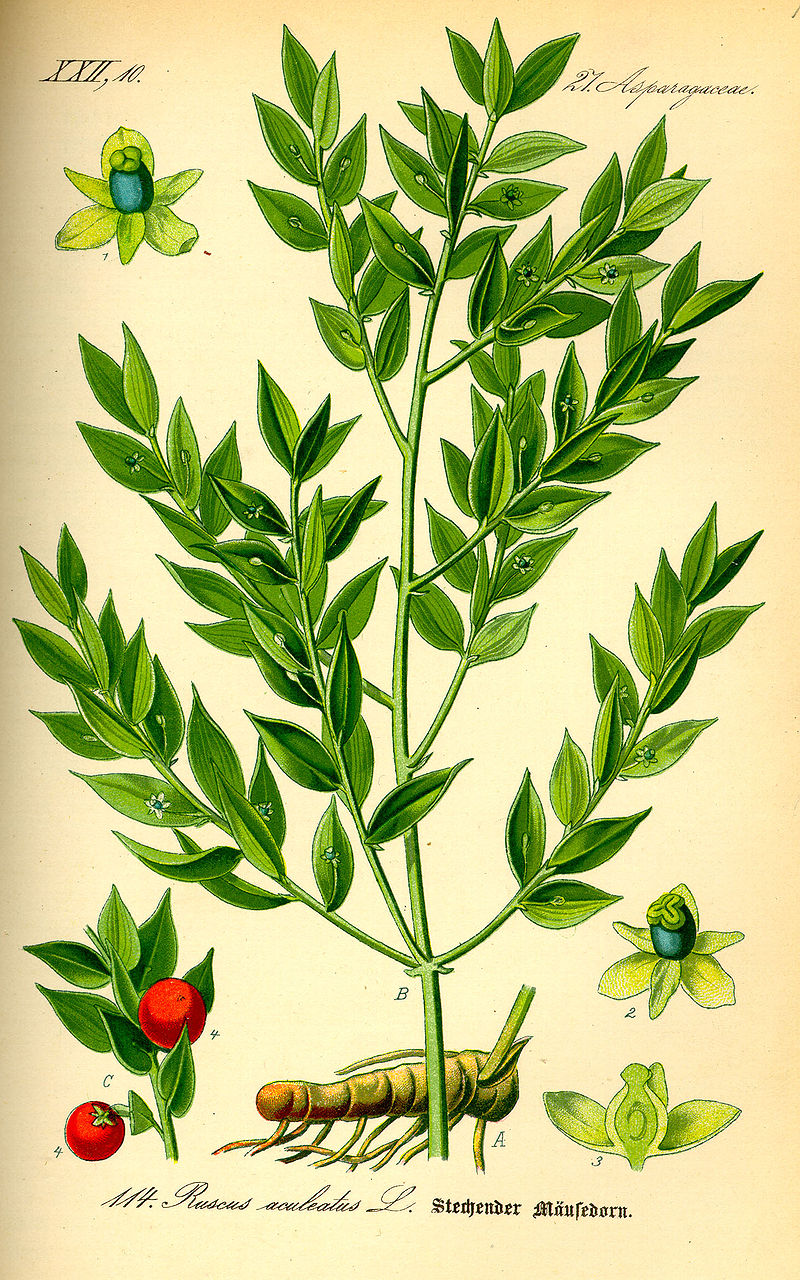
Ruscus aculeatus L.

Family: Asparagaceae
Flowering Time: Feb-Apr.

General Appearance

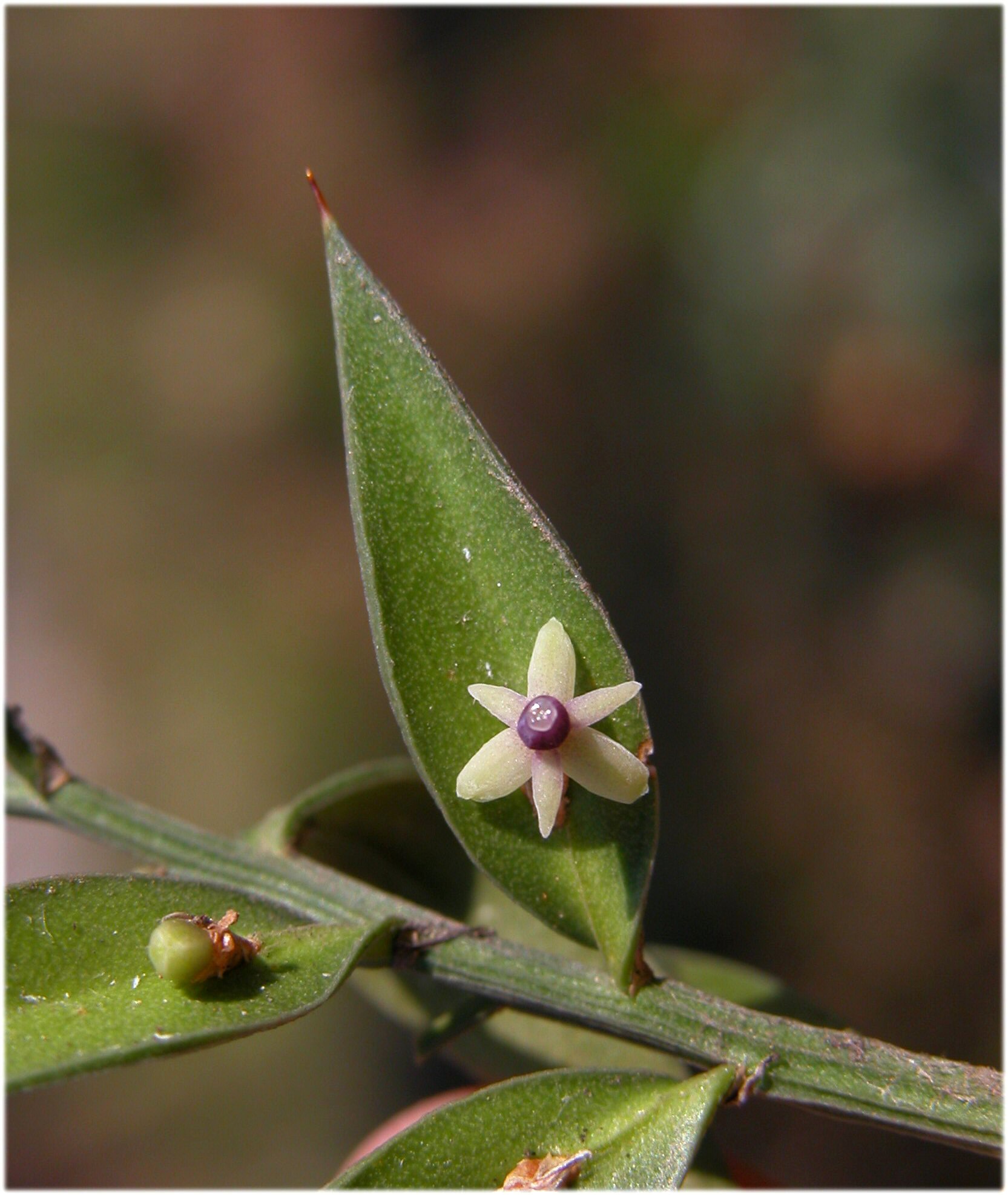
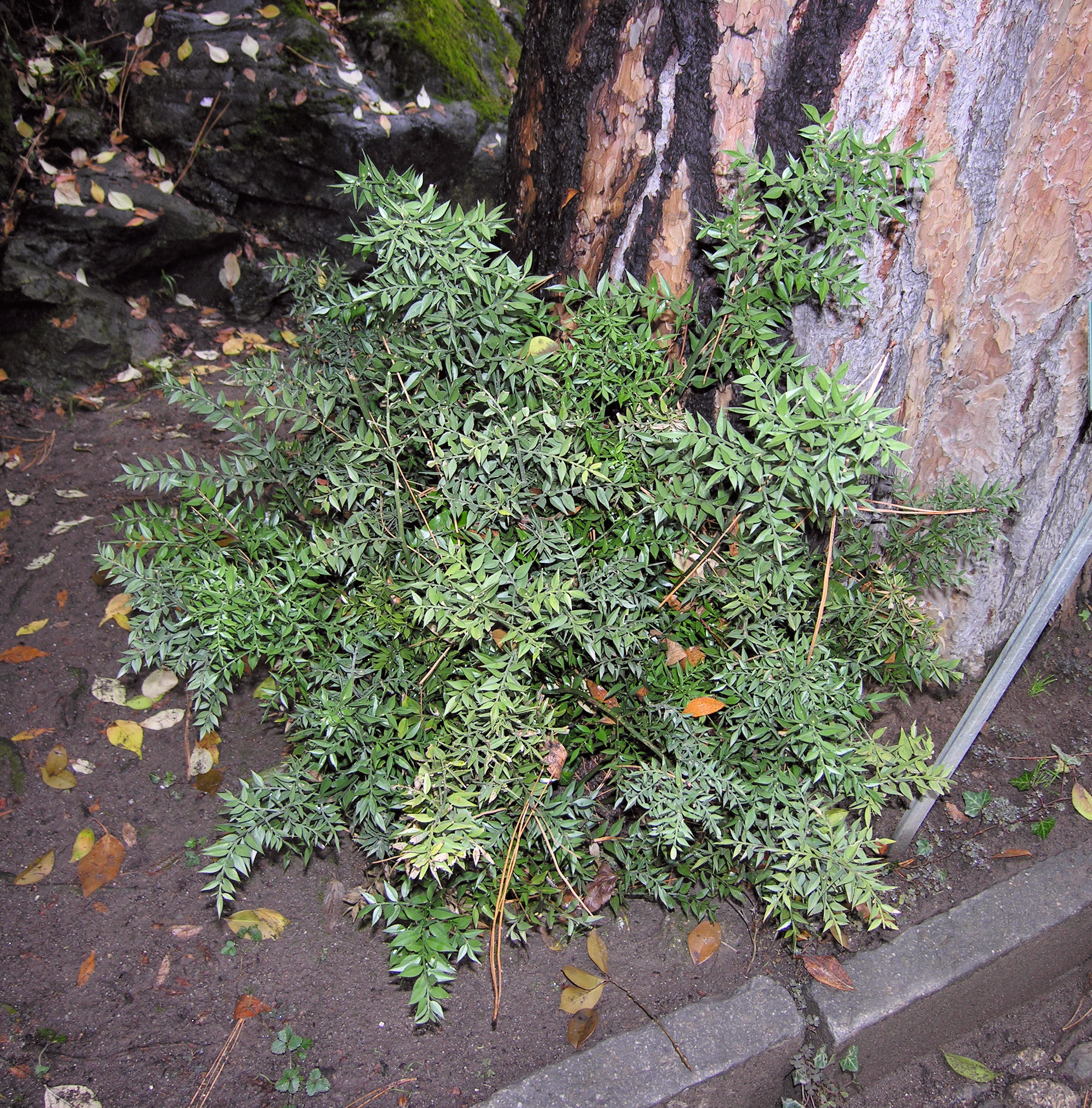
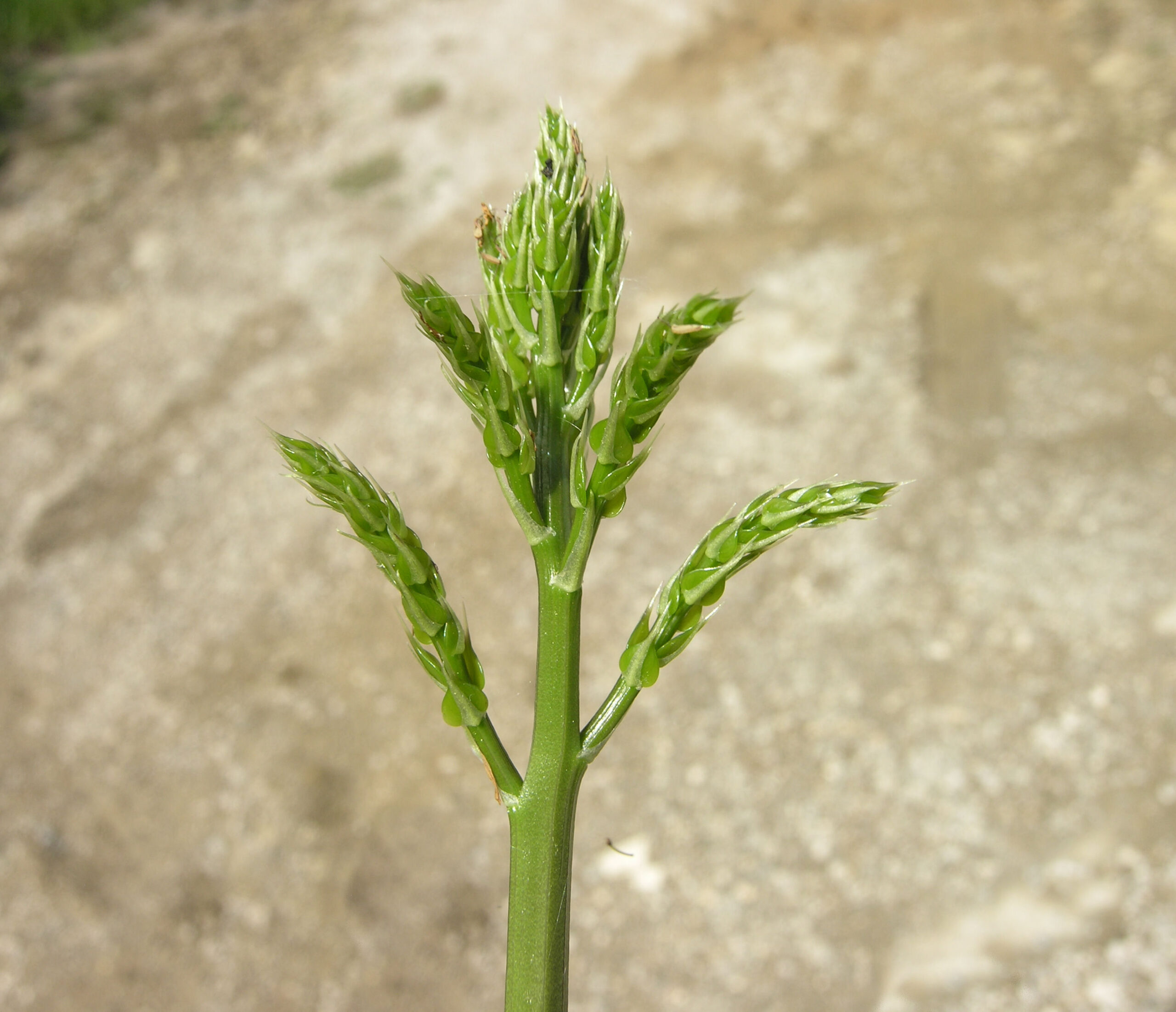
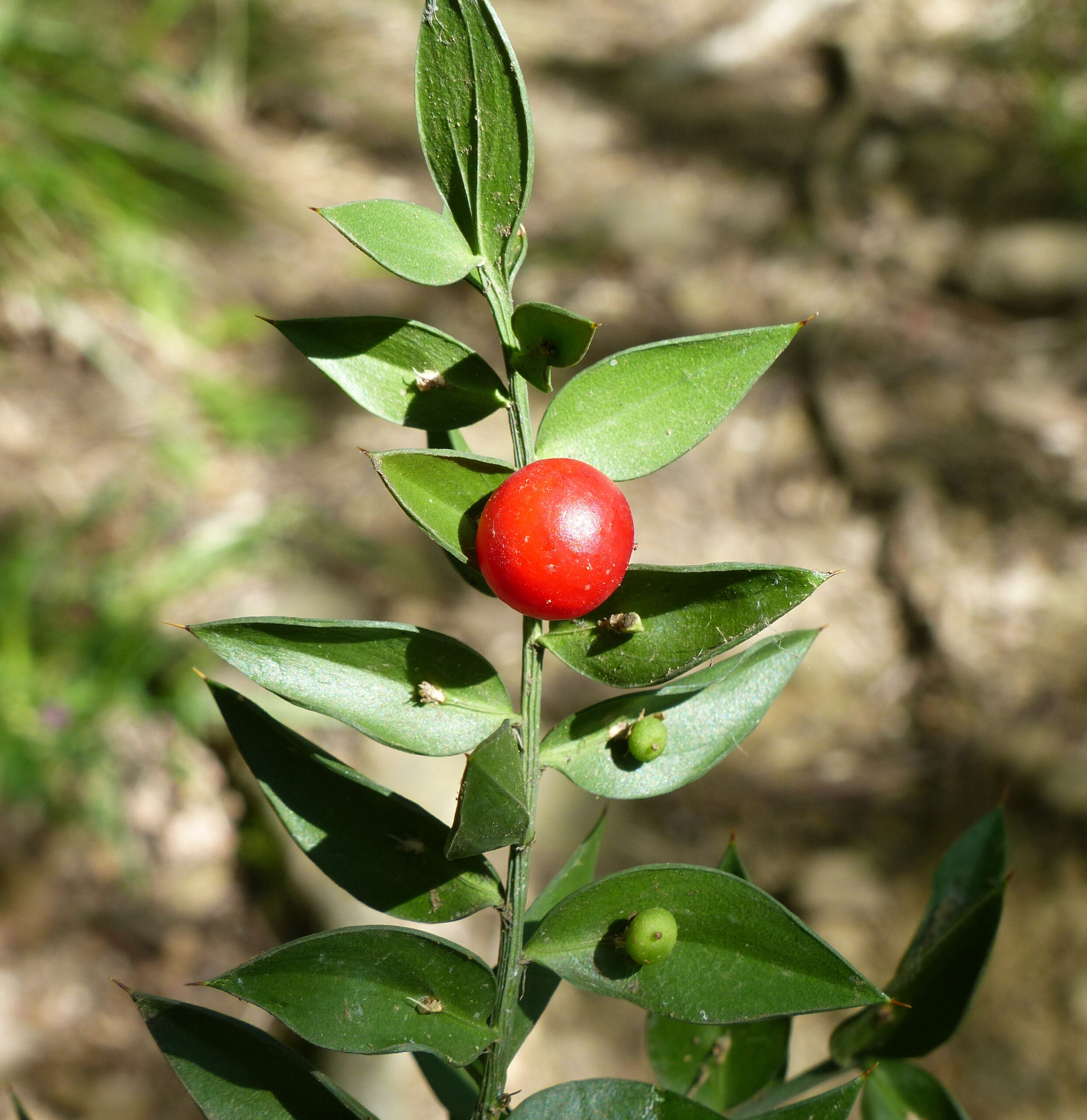
Ruscus aculeatus L.,  it is a rhizomatous geophyte, subshrub 30-80 cm tall, glabrous and green, with an oblique and creeping rootstock. Stems in a tuft, erect, bare at the base, very branched in the upper part, longitudinally striated as are the branches and cladodes, branches modified into leaf-like. Cladodes rather small, very close together, alternate, sessile, and twisted at the base, oval-lanceolate, rigid, prickly, bearing the flowers a little below the middle of the upper surface. Flowers dioecious. in fascieules of 2-(3), with very short pedicels, usually on the lower face of cladodes. c. 2 mm long. Perianth small. Tepals 6 greenish uninerved, the outer c. 2.5 x 2 mm, elliptical, obtuse, the inner c. 2,2 x 1 mm, linear lanceolate.  Berry globose, the size of a cherry, with 1-2 large seeds.

Life Form

G

Phytochoria

MED. The native range of this species is Macaronesia to Medit., W. & S. Central Europe to Caucasus.

Distribution in Libya

Al-Jabal Al-Akhader:

Cirene, Wadi Bu Nabeh 1934 Wadi (Valley) Stowah region 2007

Notes

Wild. in Libya it exists only in Al-Jabal Al-Akhader area. medicinal plant.

Link of images: https://dryades.units.it/floritaly/index.php?procedure=taxon_page&tipo=all&id=6970 https://en.wikipedia.org/wiki/Ruscus_aculeatus


First: Encyclopedia Flora of Libyan:

Jafri, S. M. H. & El-Gadi, A. (1978) Flora of Libya, Liliaceae Vol. (57) Department of Botany, Al-Faateh Univ., Tripoli, Libya.

Second: Researches and PhD theses, master theses, Sorted by Newest:

Nawras, A. M. B. (2007) A study of the vegetation cover in the Wadi (Valley) Stowah region. Master Thesis. Botany Department-Faculty of Science-Garyounis University-Libya. (In Arabic).

Leave a Reply

Your email address will not be published. Required fields are marked *