Haloxylon salicornicum (Moq.) Bunge ex Boiss.

Common Name: ——-
Family: Amaranthaceae
Flowering Time: Aug-Sept.

General Appearance

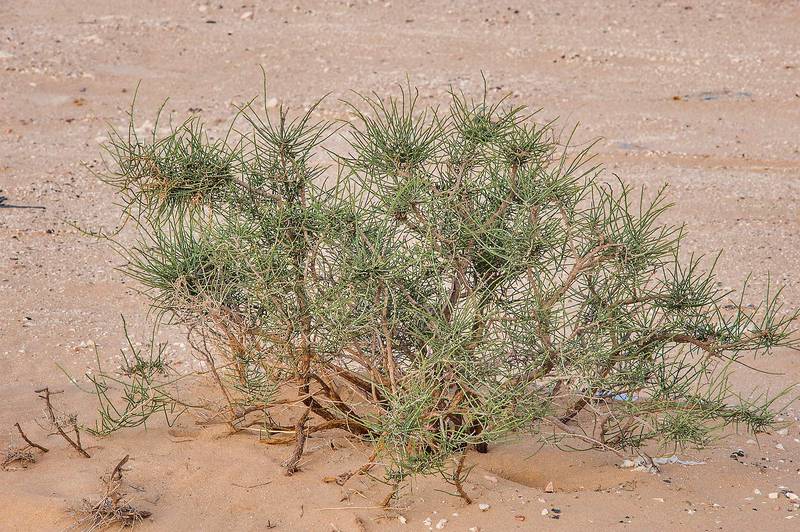
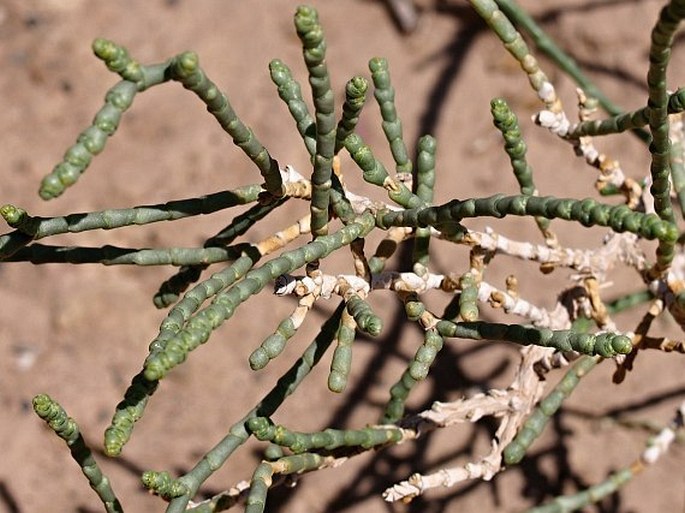
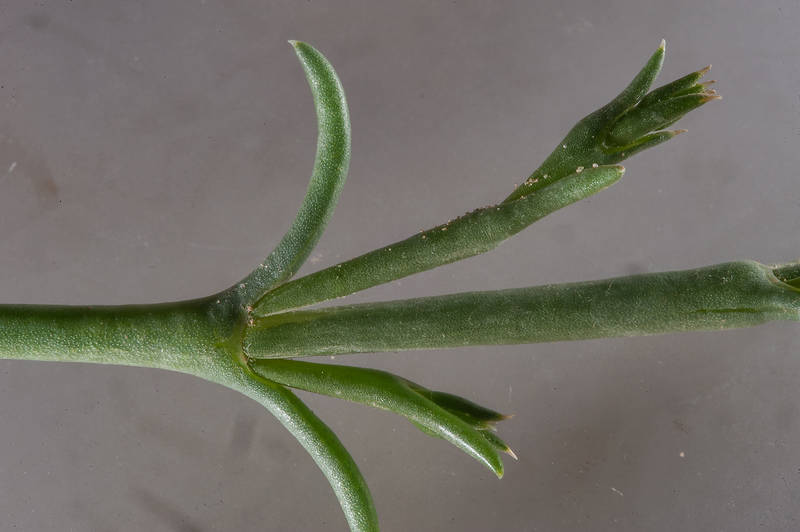
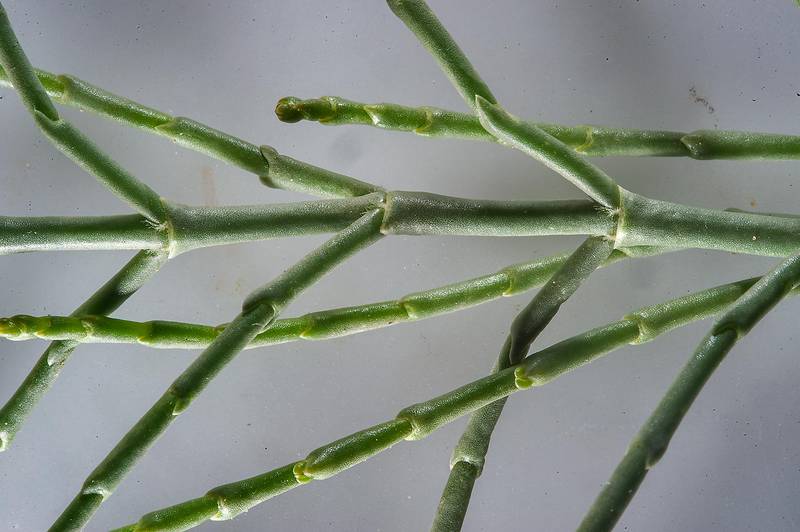
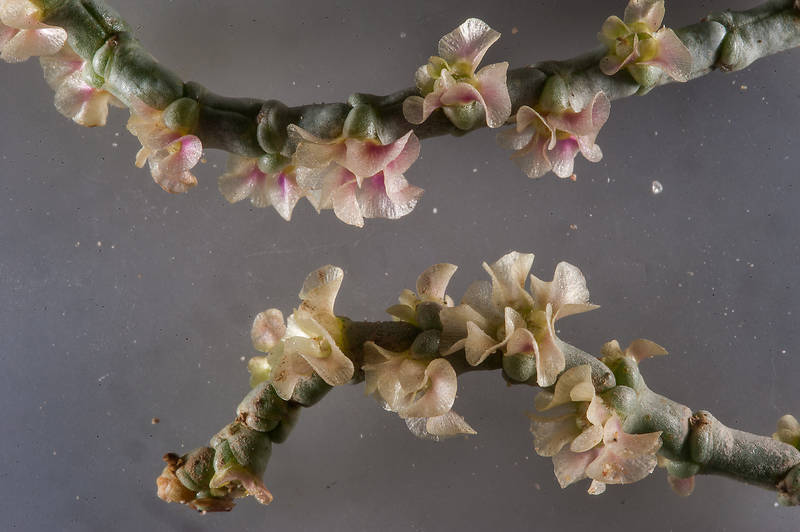
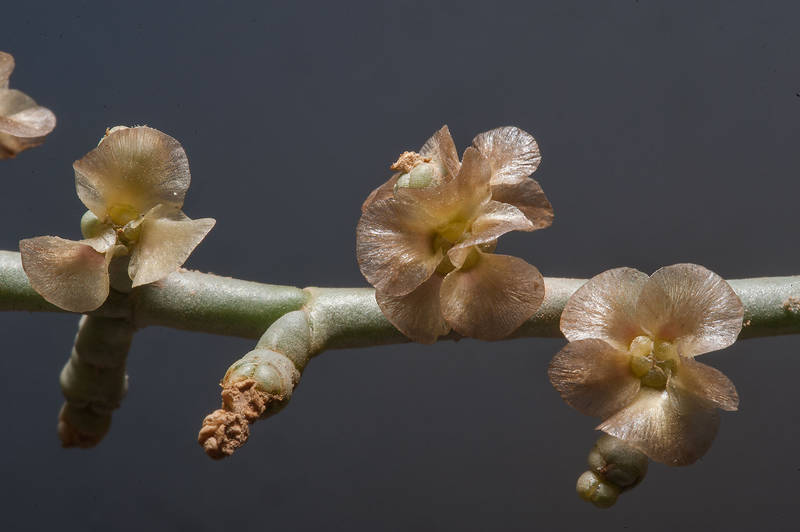
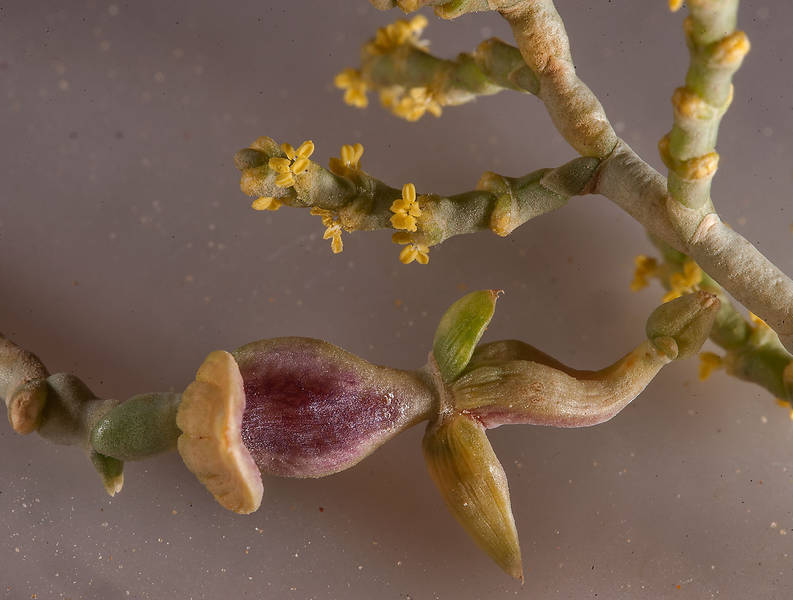
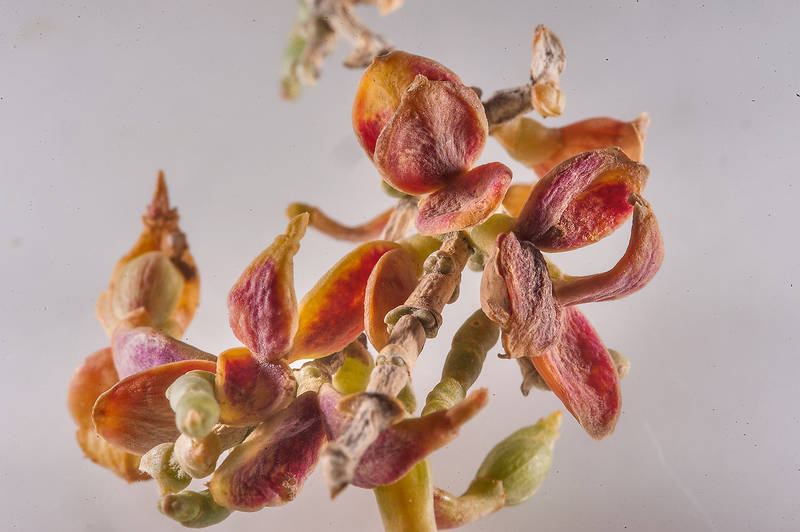
Haloxylon salicornicum (Moq.) Bunge ex Boiss. / Homotypic Synonyms: Hammada salicornica (Moq.) Iljin/ Heterotypic Synonyms: Haloxylon articulatum (Moq.) Bunge, it is a diffuse undershrub or shrub, pale, much branched, almost leafless, 25-60 cm tall, with woody stem; shoots ± ascending rigid, light coloured to white or waxy yellowish when dried. Leaves reduced to minute, short-triangular scales, connate into a short cup, membranous at margins, woolly within. Inflorescence consisting of short, 3-6 cm long, scattered spikes, mostly at the ends of pale greenish, main or lateral shoots of the current season. Bracteoles 2, ovate-concave, woolly at base. Stamens alternating with linear ovate staminodes, papillose at tips; styles short, stigmas 2, strongly papillose on inner side. Fruiting perianth including wings usually 7-8 mm across, somewhat brownish.

Life Form

Ch

Phytochoria

SS. The native range of this species is N. Africa to NW. India

Distribution in Libya

Marmarica Plateau:

Reported in Marmarica north-eastern part of Libya by Pampanini 1930

Notes

Wild in Libya, is a shrub species found in arid regions and has beneficial applications that include fruiting tops and seed as animal feed, seed as emergency food, wood as fuel, different plant parts for medicine, and restoration of degraded lands. Moreover, the species is tolerant to abiotic stresses such as drought and high temperature which make it suitable for cultivation in marginal lands of arid regions.

First: Encyclopedia Flora of Libyan:

Jafri, S. M. H. & El-Gadi, A. (1978) Flora of Libya, Chenopodiaceae Vol. (58) Department of Botany, Al-Faateh Univ., Tripoli, Libya.

Second: Researches and PhD theses, master theses, Sorted by Newest:

Saaed, M.W.B., EL-Barasi, Y.M. & Rahil, R.O. (2021) An updated checklist and quantitative analysis of the Marmarica Plateau flora, in the north-eastern part of Libya. Phytotaxa 509 (1): 001-055. https://phytotaxa.mapress.com/pt/article/view/phytotaxa.509.1.1

Leave a Reply

Your email address will not be published. Required fields are marked *